Wednesday, March 9, 2016

ZOOTOPIA Trailer #4: Smooth Continuity Editing

In Europe ZOOTOPIA is called ZOOTROPOLIS.
If there is one thing Walt Disney Feature Animation continues to excel at, it is clarity of layout, i.e. staging and pre-editing. Their extremely smooth continuity editing even extends to trailers where shots from very different scenes are cut together effortlessly. In this post, I will analyze some striking examples of how continuity editing with an emphasis on match cuts provides flawless orientation in the latest ZOOTOPIA trailer.

Btw: it would be very interesting to know who assembled this trailer. So if you have any information on that, please let me know.


Try to look "through" this image to see it in 3D.

Successful 3D
Disney (and Pixar - just think of the otherwise forgettable THE GOOD DINOSAUR) have become experts on stereoscopic 3D that is easy on the eye and very effective as a storytelling device at the same time. For one thing, they usually do not go for obvious effects that remind us that we are watching a 3D movie. They even mostly refrain from placing objects too closely to the spectator. Additionally, with Disney's trademark flowing style of animation the head-ache inducing strobing of RealD projection is virtually absent from films like FROZEN or ZOOTOPIA.

Yet one of the central challenges of narrative 3D films lies in the smooth editing. Contemporary stereoscopic 3D films are composed of just as many shots as average action movies. Since there is one more parameter (convergence of our eyes to virtual layers of depth) for the viewer's eyes to keep track of from one shot to the next, smooth continuity editing is paramount for clear orientation.
[Note: Of course, I cannot (yet) examine it in 3D on this blog, so just keep this in mind]

Audiovisual continuity
If you are interested in seemingly invisible editing techniques for fast cut scenes, look no further than the formally unspectacular ZOOTOPIA trailer #4. Since a trailer's basic incentive is selling a product, it makes sense to make it as easily accessible as possible. While I personally prefer the more audacious trailers for films by the likes of Hitchcock (PSYCHO, ROPE) and Kubrick (DR. STRANGELOVE and THE SHINING in particular), this mainstream trailer below contains some amazing lessons in the classical technique of continuity editing:


Assembling a trailer is first and foremost a dramaturgical task: telling a story in two and a half minutes based on previously produced footage. In the video above, there are the usual structuring elements like fades to and from black, five of which are hard cuts to black on musical beats that then fade in (I marked all the cuts that match musical beats) as well as aural continuity by way of Shakira's "Try Everything" (and a Nino Rota pastiche in the GODFATHER epilogue).

Three dissolves serve to indicate more quiet moments even though the change of pace is merely simulated by overlapping two longer shots. The slow dissolve at 1:27:22 also gives us time to look from the left (previous composition) to the same character on the far right in the new composition.
The "sad moment" dissolve simulates slower timing by overlapping two shots.
With an average shot length (ASL) of less than 32 frames (1.3 seconds), the trailer does not leave us much time to linger on details or even adjust to where to look at. Therefore it is important that our eyes do not have to scan the whole frame for the main point of interest. Of course, the most obvious solution to guiding our perception are matching eyelines: we look at a character on the left and in consecutive shots automatically look to the right to see what they were looking at.

Reverse Angles in Widescreen
As you can see in the following images, even though the director could block the conversation partners far away from each other in a cinemascope frame, their eyes are rather close to each other from shot to shot (indicated with red lines). There are also visual similarities in the overall composition that soften the cuts (green lines):
Green lines: position of the backrest on the left and red object as well as lighter area on the right.

Green lines top: positions of Judy (object) and Bogo's fist. Bottom: the hand matches exactly, while Judy is slightly more to the center so that we do not have to move our eyes too much from Bogo's head to hers.
This last shot is especially interesting because it comes from a totally different scene (after Judy fails to produce the rabid Jaguar). However, it is cut at the exact moment when Bogo's fists match. It also helps that the high angle on Judy is the same as in the previous setup on the chair.

Characters are even closer in such shot - reverse shot conversations throughout the film as you can see in the following example that always places us closer to Judy. [On a side note: this is even more striking in 3D where we do not read the staging in the long shot as flat at all because Judy is much closer to our position in the room.]
Here Judy's position is even matched perfectly.
The usual "single" in the middle of the "two shot" setup, with a graphic match in the background.
A two shot vs a single that is basically a two-shot as well.
In terms of content, these setups (above) reinforce the theme of size relations that appears throughout the film.

Match Cuts Within a Setup
When two characters face the same direction, the filmmakers almost match the positions of their faces in consecutive shots. Since eyelines are maintained and there is enough visual information to understand who is on the left and on the right, this greatly helps us in keeping track of the main point of interest in a shot without moving our eyes!

The characters (and by using different lenses even the police banner) appear in the exact same spot in the middle of the frame while the lion's suit, tie and paw clarify their spatial relations. Although these are not consecutive shots in the film, their juxtaposition works perfectly.

The visual match does not necessarily have to be in the middle: in the "four shot" (24:03 below) our eyes are guided from the bunny (and the eyeline of tiger and wolf) to the Rhino's eyes by the timing of the action/movement within the shot. As we are looking at the Rhino, the cut places our bunny protagonist Judy at the exact same spot.
It is important to notice that the red lines only indicate what we are supposed to look at in the very last (top) and first (bottom) frame of a shot. Within a shot our eyes may be guided all around the frame from one character to the other, of course.

Cutting on action - in this case Judy reaching out to Nick - is made even less visible if the lateral position of the brightest part of what moves is matched:

With a characters face in the same position you can change the angle on the background almost any way you like without our noticing it:
During the following cut from a low angle to a far away high angle the whole background is changed. But since the fox and the buggy on which we focus are matched, this is almost indiscernible:
The same goes for the following scene where Judy is standing in the street vs sitting in her cart. No jump cut perceived here:
In the following scenes there is a lot of footage missing from the actual scene but the ellipsis works very well because Judy's lateral position is exactly matched. There even are sort of visual matches left and right of her, but those may be purely accidental.

My favorite moment is a very short cut-on-action sequence taken directly from the film that connects a near 180° reverse angle by matching jaguar paws so perfectly that even in 3D it felt like one single shot!
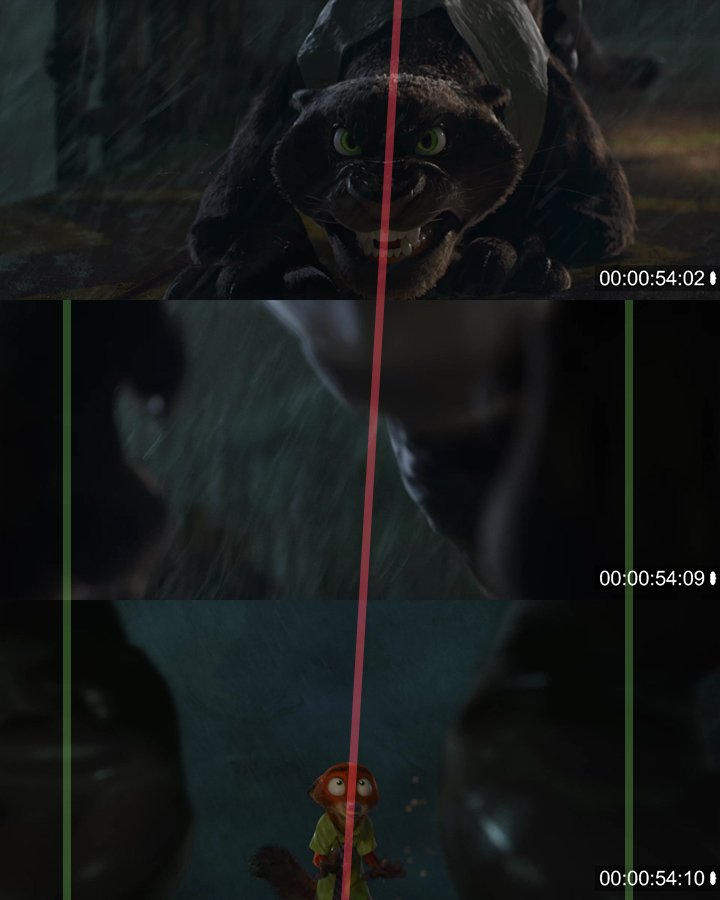
The eyeline match is from slightly right to slightly left of the frame center...
...while the paws on either side mask the cut almost completely (much brightened for this GIF).
In the scene within Mr Big's limo, the active part of the scene is almost exclusively within the right half of the frame with Nick the fox. Thus it makes sense that the driving car (from later in the movie) is cut when it approximately hits the lateral position of Nick in the next shot.

Within the shots, Judy is talking to Nick and our eyes wander back and forth. But overall, the interesting action is Nick searching the car. When the polar bears appear at the door, the one on the right is obviously more dominant since Nick looks slightly to the right and the right bear is larger and higher in the frame and slightly brighter than the one on the left.

When Judy realizes that "they're all Sloths", in the trailer we get a series of shots that all are framed like shot - reverse shot scenes but with all the moving or speaking characters on the left and the onlooker/overshoulder observer on the right:

It does not even matter that we are looking at different sloths as long as they are...

...changing position from right to left and back like in a reverse angle situation.

We start and end on Judy's reaction to their slowmotion behavior.
In these GIFs I only use the first and last frame of a shot (see timecode).


Match Cuts Across Scenes
The scenes we have seen so far are mostly working so tightly because they were planned that way in layout. After all, those shots came from within continuing scenes. Whoever cut this trailer, however, was able to match footage from different scenes in a completely seamless way.

The following match of two news anchors with a reporter and a cameraman may in fact come from the same scene, but if I remember correctly, those are not consecutive shots in the movie. Be that as it may, in both scenes we are focusing on the left character in both shots because it's only them who are talking.
Although both characters' positions match and we focus predominantly on the left half...
...their head sizes are reversed, making this look like reverse angles.
A less obvious but more elaborate version can be seen in a montage of animal behavior that uses shots from three different scenes (the nudist yak's lobby, the nudist's garden, the howling prison guards).

We cut from a left to right movement to a howling wolf slightly to the right (matching the panther's gaze).

Then the weight is shifted from the white to the gray wolf approaching from the right that shifts more to the center after the cut to the medium close-up.


Then we have the yak's naked rear more or less matched with the giraffe's and Judy's face turned away matching that of the giraffe.

Purely Visual Associations
Sometimes the position of a character is different. Yet we seem to recognize the same set because certain objects, colors or lighting appear to stay in the same position within the frame. Of course, the following is not a real match cut. But the GIF animation makes it clear how closely the beds match (the only part of the image that really is the same). The lighting source on the right and especially the radio that substitutes for the doormap are very interesting choices:
Up to now, the main point of interest in practically every shot was located somewhere in the middle section of the frame. That might well be the case because in 3D we do not like to be reminded of the left and right frame edges because occasionally this can destroy the illusion. But in the top shot above (Judy on the far right), we are looking at a rectangular room that hardly extends beyond the frame edges so there is less danger of breaking the illusion.

There are however some cuts that remind me of the opening shots of all the Indiana Jones Paramount logo matches:
Here, not only the castle is matched (after fading out and in, to be fair) but also the angle (look at the horizon) and the style and perspective of the clouds.


In the next shot the object in the distance is again matched while we cut to a much closer view of the same train top sight seeing window.

Visual matches not based on characters and eyelines are also visible in the following scenes:
Another one of my favorites and maybe just a coincidence. But since the train accentuates the diagonal line before the cut, I can't help but notice the same graphic element in the elephant scene. 

As I have stated above, size relations are a dominant theme which is perfectly illustrated by cutting from a food corner for Giraffes to a miniature car that occupies roughly the same space in the frame. The contrast is heightened by the green vs red background:

Matching Movement
And then there is one seamless match-on-action that not only works because of the positioning slightly to the right but because it completes a left to right movement that starts with Judy cleaning the plate and ends with the cart driving to the DMV (for motion check the trailer at the top of this post):
This approach certainly helps when mashing up two different action sequences into one dynamic swing. Again I have only used the first and last frames of each consecutive shot for this montage:
Starting with a diagonal composition triggered by a roaring lion (last frame of first shot) the trailer cuts to another diagonal line with the fox on the left that segways into a series of shots that have the characters swinging to the right and ends with a very kinetic shot-reverse shot upward diagonal sequence from two different scenes.

Although the point of interest is shifted slightly downward to the left we can see that...
...the overall movement is upwards and to the right.
Conclusion
Of course, most of what we see here is fundamental continuity 101 that we all know of. And by no means would I want to discourage you from finding more original or unique ways of staging and editing (for more interesting action staging across the whole widescreen frame see David Bordwell's examples).

But if your objective is to maintain screen orientation and geography without irritating the audience in fast cut scenes - we are looking at a trailer that is usually consumed only half consciously - then (near) match cuts are a very powerful tool. Especially fast cut action scenes benefit from clarity as can be witnessed in the center framed action sequences of George Miller's MAD MAX: FURY ROAD, where even shots of only 4 or 5 frames register because they are matched before and after.

If 3D, fast cut action films or intensified continuity are not on your mind, then by all means find ways of staging your characters in ways that make use of the full widescreen frame!

Of course, it is vital to cheat continuity on purpose for myriad reasons - and animation offers more tools (e.g. character sizes and proportions can change according to story or mood needs) than live-action - but there is absolutely NO excuse for accidental continuity errors in animation.

Friday, November 6, 2015

Moving point-of-view shots in TOY STORY

In celebration of the 20th anniversary of the TOY STORY premiere (Nov 19, 1995) I have put together my very first video essay. A lot has been written about how the success of this first fully computer animated feature film was based on the great storytelling and how plastic toys were an ideal subject for computer animation. But the Pixarians also played to the strengths of computer animation in the way they organically incorporated three-dimensional compositions and camera movements hardly possible in hand drawn animation. Thus, in my essay I focus on the crucial functions of the moving point-of-view shot in TOY STORY. Here, the narrative perspective is more restricted than in all of Pixar's subsequent films. 

Since the video essay was done for the Swiss magazine filmbulletin, the commentary is in German only. Therefore, I provide you with an English translation of my running commentary and the German intertitles. filmbulletin is not an animation specific publication so there might be some explanations in the video that are second nature to anyone working in animation.

Please find the video essay here.

Translation:

0:16
In computer animation, the virtual camera is theoretically able to move completely freely. TOY STORY is consistently told through the eyes of toys. In order to communicate this perspective, the filmmakers resort to a popular storytelling device of adventure and horror films that is especially suited for computer animation: the moving point-of-view (POV) shot.

0:54
I. An unusual perspective
Many Pixar films show us a well-known setting from an unusual perspective. In TIN TOY for instance, we see a playing baby through the eyes of maltreated toys. In order to visualize this narrative perspective the camera is lowered to the tin toy's eye level. From this angle the baby becomes a monster.

The toys' strong facial expressions suggest that these toys are consciously acting beings.

Compare them with the mechanical doll in CHILD'S PLAY: Here, the mechanical expressions do not hint at any real consciousness. However, the film tells us that Chucky is indeed a living being in a different way: the camera lets us see through his eyes and shows us his subjective view in a so-called point-of-view (=POV) shot, which I will henceforth mark with a yellow frame.

2:11
Likewise in TOY STORY the toys do not seem to have a life of their own as long as humans are present. However in the opening scene John Lasseter shows us by means of interspersed POV shots that the cowboy Woody is perceptive and therefore has a consciousness of his own even though his eyes look lifeless from outside.

Without these POV shots the exterior action would still be completely comprehensible. WITH the POV shots the audience gets the additional information that Woody is perceiving these actions consciously.
        Point-of-view     vs     blank reaction shot
Yet, the POV shots do not reveal any of Woody's emotions. Characters are emotionally charged not by POV but by reaction shots of the viewing character's face. In the company of humans Woody's face remains blank, though. Therefore, his reaction to gazing at the birthday garland is only revealed after Andy has left the bedroom.

From then on, we do not need any POV shots any more to be reminded that the toys are alive.


3:35
II. Visual rollercoaster
In adventure films moving POV shots are often used to convey a physical experience to the audience. For technical reasons, such forward movement (trucking in) is very rare in hand drawn animation.

Visual depth can be suggested in horizontal und vertical movement by moving several painted (multiplane) layers in relative speed to one another. If the camera is trucking in through these layers, the two-dimensionality of the painted objects becomes visible because they lack perspective distortion. Real trucking POV shots are mostly so short that this is not showing.

If the truck-in-movement is the focus of a shot, the background has to be redrawn for every single frame (24 times per second) in hand drawn animation. In western commercial animation, such a painstaking technique is hardly used for anything else than cartoon settings without too many details.
Since this kind of POV shot is often conveying the experience of a rollercoaster I like to call it the "rollercoaster perspective".

4:48
In computer animation the virtual camera is indeed able to move freely within the three-dimensional space. Ever since the late 1980s computer animated POV shots are integrated into hand drawn features as well.
In the completely computer animated TOY STORY the rollercoaster perspective shows us the psychologically distorted perception of Buzz Lightyear.
Buzz does not know that he is a toy. He believes he can really fly. From Buzz's first person perspective it may look like he is flying. In reality, the alleged "flight" is the result of gravity and coincidence.
Buzz also believes that his toy weapons are really working. We see them like in a first-person-shooter (complete with gun in the middle perspective of vintage arcade games). When Buzz realizes he cannot fly after all, we get two POV shots again.

After Buzz has accepted his existence as a toy we learn from Woody's perspective that flying is not a question of capability but of perception.

6:30
III. Creating suspense
Since we cannot control the characters' subjective perspective in films the restricted field of vision is creating tension because danger in films is mostly lurking off screen. This can come as a surprise (Woody: "hello?"). It is much more suspenseful when we expect a potential threat.

In SILENCE OF THE LAMBS we know that the heroine is in the house of serial killer. By alternating POV and reaction shots of Jody Foster's face the filmmakers let us read her emotional state.
7:21
In TOY STORY Buzz and Woody know that the neighbor Sid is fond of destroying toys. Like the audience, Buzz and Woody cannot control their restricted view because they are trapped in Sid's bag while entering his home.

Only later on the run they are controlling their own perspective again. In addition to Sid, this house (which alludes to the hotel in THE SHINING) holds many more threats.
One of them is a pit bull called Scud. Since Scud is able to see the secret life of toys we can assume his POV as well. However, knowing his emotions and seeing through his eyes does not automatically lead to emotional identification with the gruesome dog (although we may be fascinated by his villainous behavior). Our emotional commitment to a character is much more dependent on his behavior towards other characters. Thus, Scud remains a threat even though we see share his perspective.
POV dog
8:25
IV. Insight into the toy world
The moving POV shot is fulfilling three basic functions in TOY STORY:
1. we see that supposedly lifeless toys are conscious beings.
2. it conveys physical experience from the perspective of toys.
3. the restricted field of vision is creating suspense.

Since TOY STORY is consistently told through the perspective of toys (and animals), we share their visual POV exclusively - for the most part that is. Towards the end, however, we surprisingly see through the eyes of Sid (unlike the many overshoulder shots we get before).

Although the restricted narrative perspective only allows for scenes in which toys are present we can - as we have seen with the dog before - share the visual perspective of all those characters who can see the secret life of the toys. After all, the toys reveal their parallel reality to Sid for a short moment (technically, this still does not explain the first Sid POV, but better break a rule than minimize impact).
Andy's baby sister Molly catches a glimpse of the living toys as well. However, she will not be able to tell someone and no one will believe Sid, anyway. That way, Andy will never find out that his toys are really alive.

Note: In subsequent Pixar films, point-of-view shots assume may different, sometimes really original functions like a "second person flash forward" in FINDING NEMO or a view through the mindless eyes of Emperor Zurg in TOY STORY 2.