Annecy always reminds me how thriving the animation community is and this year's edition was no exception. In the end, I may not have seen as many films as I would have liked but the combination of wonderful people, sunshine and two pedalo rides more than outweighed that, especially looking back eight days later.
As always, I also discovered bandes dessinées I have never heard of and was introduced to the works of inventive animation directors that had previously slipped under my radar. For example, I wouldn't have chosen to go to a screening of Crystal winner
LU OVER THE WALL (Yoake tsugeru Rû no uta) if my friends had not already had tickets and knew what they were in for with
Masaaki Yuasa.
 |
| Overwhelming water animation in LU OVER THE WALL. |
Some 2017 Favorites
My favorite film was certainly
MIN BÖRDA (
Niki Landroth von Bahr, 2017) from Sweden in which a couple of lonely animals "sing" about their isolation. If you're not sold after seeing the singing fish in the trailer below (how could anyone not be), then surely the prospect of an animated
Roy Andersson short film will get you interested.
The Burden (Min Börda) - trailer from
Niki Lindroth von Bahr on
Vimeo.
MIN BÖRDA was one of several stop motion films that included a long shot showing the whole set from an outside perspective. In contrast to the more meta-level versions (akin to Fellini's E LA NAVE VA, 1983) in several other puppet films, in MIN BÖRDA it actually was a diegetic shot, though.
NEGATIVE SPACE (
Ru Kuwahata/Max Porter), another stop motion short, stood out to me not only because the tone of the storytelling was just perfect but also because I really admired the careful animation, especially the make-believe wave on the beach.
Negative Space - Trailer from
Tiny Inventions on
Vimeo.
With the advent of digital cinema, the once extravagant cinemascope aspect ratio (1:2.39) is available to even the most underfunded film maker and therefore increasingly popular. What does not automatically come with a wider frame are the skills it takes to make such compositions work (as has been already proven during the 1950s in live-action cinema). Thankfully,
Michelle and Uri Kranot mastered the format in
NOTHING HAPPENS, a film "about watching and being watched". And as I have learned on vimeo, the film that with all its fixed camera setups looked so non-digital on the big screen is also a virtual reality experience:
Nothing happens- an animated virtual reality experience from
Michelle & Uri Kranot on
Vimeo.
Being always alert to color trends, I noticed how many of the films I liked made heavy use of blue either in conventional terms of cold v warm, orange - teal or more boldly like in
MATERIAL WORLD (Anna Ginsburg) that won the
Annecy Crystal for best commissioned film.
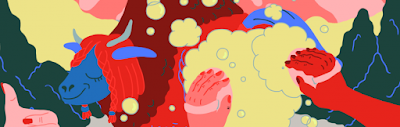 |
| The beauty of instructional videos: MATERIAL WORLD |
In that light, it certainly fitted perfectly well that in the very same commissioned film program a CNN explainer addressed the very color:
Blue - CNN from
Moth on
Vimeo.
The commissioned films program was a real delight because it provides a nice usually give you a nice overview of current styles popular in the more inventive sections of advertising. And for me, getting an overview is one of the things that also draws me to internationally renowned annual short film competitions like Annecy.
Some concerns about short film compilations
The programming of this section, however, is highly problematic. If you saw only one or two screenings instead of all six, you would come to an extremely distorted conclusion about current trends in animation. Because:
A) not only are many of the more experimental films lumped together into one single "off-limits" program (which both makes it harder to process them all and turns away many a viewer who normally would not mind a challenging experiment in between more easily accessible films), but also
B) the films in the five "normal" competition compilations seem to be increasingly segregated as well by style/technique and even content (I wasn't alone with the impression that I saw a program full of meta-stop motion films and one full of either handpainted or pixilation/live-action-animation combinations). It may make sense from a critic's point of view to compare three similarly themed stop motion films that feature invisible imaginary walls, but to the audience the effect is more like "oh, another one of those" which does not do the individual films justice.
Brush strokes and the power of voice acting
But to close on a more positive note: a packed Bonlieu, Grande Salle is still the most exciting place to see a film on the big screen simply because it produces the most enthusiastic audience I have ever seen. And this, of course, was the case on my first day, when I thoroughly enjoyed the first "public" screening of
LOVING VINCENT and contributed to a ten minute standing ovation that made it into Variety.
Writer-director
Dorota Kobiela had the crowd on her side right from the beginning when she emotionally dedicated it to her grandmother. What most surprised me - and ultimately convinced me despite the film's many flaws - was the fact that the concocted mystery plot worked so smoothly. Maybe a bit too smoothly and certainly too rushed at times when everything that vaguely resembled a reflective moment was plastered with Clint Mansell's far too obtrusive score before I had time to catch a breath.
But - and that is a much more serious problem - the film, well-acted as it is by the likes of Chris O'Dowd and Soairse Ronan, would easily work as an Irish radio play which literally means that apart from a few imaginative scene transitions the filmmakers failed to make use of the visual potential of a feature film consisting exclusively of oil paintings and simply illustrate talking heads. For sure, the paintings are expertly executed, the flow is a lot better than in almost any rotoscoped feature I have seen and the colors alone are a fantastic treat. But narratively, there is nothing gained from the brush strokes, no new insight into the characters that is not already in the dialogue. Stylistically, despite the unifying rotoscoping, the well-proportioned actors walking through off-perspective backdrops often reminded me of the Dali dream sequence in Hitchcock's SPELLBOUND where Gregory Peck stumbles through deliberately unbalancing expressionist/surrealist sets.
 |
| LOVING VINCENT: live-action v rotoscoped in oil. |
But still I enjoyed it and I warmly recommend seeing it. Even if mostly for pulling this feat off and hopefully making people all around the world re-discover an artist who is so popular today that we take him for granted. And if that comes through a combination of eye candy and tv style murder mystery, so be it. I'd rather see that one again over yet another superhero origin story.
Speaking of origin stories: the basic parent - child relationship inherent to any origin story seems to have replaced the love story as the primary emotional trajectory of mainstream films from BEAUTY AND THE BEAST (Condon, 2017) to LOGAN (Mangold, 2017) or ROGUE ONE (Edwards, 2016). Thus, it came as no surprise that many films in the shorts competition dealt with remembering a recently deceased parent. A special treat was PÉPÉ LE MORSE (
Lucrèce Andreae): a prime example of fluid, atmospheric storytelling - at 15 minutes it never dragged - and strong voice acting which I am very partial to yet which is not so easily found in animated short films.
Pépé le morse - Teaser from
Lucrece Andreae on
Vimeo.




 Posts
Posts

