Thursday, October 31, 2013

Cutout Wolf

The last few weeks, I have been busy animating clips based on illustrations by Brigitt Andermatt for a live performance of Sergei Prokofiev's PETER AND THE WOLF (Петя и волк) by a local orchestra (Orchester Cham Hünenberg). To make up for a lack of substantial posts, here are two exclusive clips (without any sound, obviously).

Illustrations by Brigitt Andermatt
Live-action backgrounds by Remo Hegglin
After Effects animation and compositing by Oswald Iten.

Doing cutout animation for a change was a very interesting experience. After all, it would have been impossible to animate 35 minutes of music and dialogue in a hand-drawn style, even if animation was only used to give a hint of life to otherwise static illustrations.

I was actually glad that Brigitt had already done the illustrations when I joined the team as I would have been too strongly influenced by Disney's 1946 version that I have loved for years. As soon as I had learned about the project, I didn't allow myself to see it until the shows were over since I was also responsible for color styling of the more abstract scenes. Now that the shows have been successful, I am looking forward to revisiting it.

Tuesday, October 1, 2013

THE LITTLE MERMAID: Circles

Today marks the release of THE LITTLE MERMAID (1989) on blu ray. It is renowned for being the first film (in the wake of ROGER RABBIT's success) of the 1990s "Disney Renaissance" under the reign of Jeffrey Katzenberg and Peter Schneider. Much has been written about it in the last 24 years concerning Disney's return to fairy tales, the film's imprudent reinforcement of antiquated femininity conceptions, and its role as a precursor of the 1990s teenage love story formula that led to the demise of hand-drawn animated blockbusters.

In this post I will examine the graphic shape of the circle as a design element and a recurring motif for Ariel's longing throughout the film.

THE LITTLE MERMAID introduces us to two worlds that are separated by the surface of the sea. The one above - our world - is mainly ignorant or uninterested in the world underneath except when it comes to seafood. Those below are ordered to stay away from humans altogether by well-meaning but narrow-minded patriarch King Triton.

Circles of Hope: Above the Surface
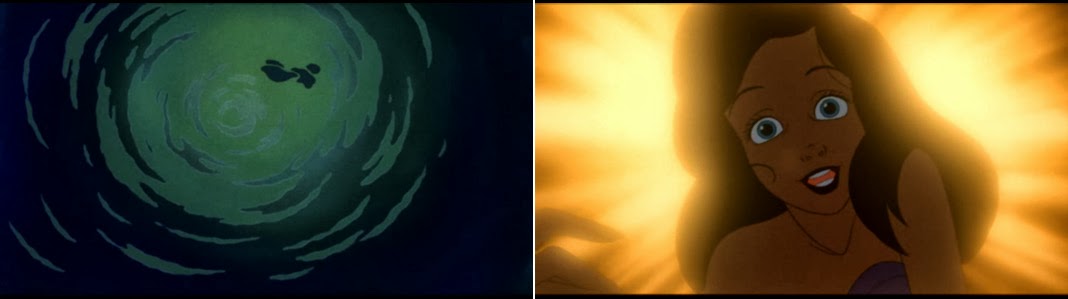
Triton's youngest daughter Ariel, however, is an energetic and free-spirited teenager of 16 years who is desperate to learn more about these humans and is glimpsing into the sun whenever possible. From underneath, the ocean surface is made visible by the round reflection of the sun. This image is introduced less than three minutes into the film during the credits sequence.
The circle that represents the sun is used as a symbol of Ariel's longing in the first half of the movie. In addition to that, circular (and oval) shapes are omnipresent in the design of the underwater world from the serpentine skeleton of Triton's palace to Sebastian's performing stages.

The circular shape is also emphasized when it comes to holes for characters to peek or swim through, especially portholes in the form of a bull's-eye. Ariel enters a ship wreck through one which Flounder gets stuck in. The pay-off to this plant is happening within the same scene as is common in children's films: Flounder is luring the shark to swim through an iron hole so narrow that they can trap him. Later, the seagull Scuttle (what an apt name) witnesses a crucial revelation by peering through a bull's-eye of a ship not yet wrecked.
Ariel's secret treasury is combining the hole with the sun reflection and communicates her single-mindedness perfectly in the form of a tapered tube directed towards the sun of the human world. It may be a coincidence that this setting is evocative of Scuttle's telescope earlier in the movie, the effect is definitely the same.


Then, with all attention guided towards the circle of light, it is obscured by the silhouette of a large ship. Ariel meets Prince Eric and a storm is wrecking the ship.

During the dramatic rescuing sequence, circular shapes and forms are emphasized in the special effects design. When Eric finally catches a glimpse of his saviour he as well is staring into the sun which looks like a halo above Ariel's head.
So after this moment, Sebastian is unable to convince Ariel to stay within the boundaries of her father's realm, no matter how many circular bubbles and sun-like blow fish he produces.

Ariel has already been lured into selling her soul to the devil.

Circles of Evil: Transformation
Little more than ten minutes into the film, we have already met the villain's sidekicks/spies Flotsam and Jetsam whose combined magic eyes transmit video images to Ursula's crystal ball.
It is certainly no coincidence that the extremely reclusive Ursula (allegedly since having been overthrown by Triton) is dwelling inside a snail shell at the end of a long tubular corridor (actually a fish carcass). Here, in her innermost sanctuary, concepts of female behavior are contrasted and discussed.


left: Ursula likes to move her tentacles in circular ways.
And in this fortune teller's tent full of circular shapes we are about to find out that Ariel's voice itself is a ball of light not unlike a small sun. Or in other words: to be able to live in the sunlight above, she has to trade in the sun of her own personality. As teenagers often do, she is letting herself be talked into trading the one thing that both defined her as a person and let her express her views and feelings. From here, the story could have taken a different turn towards many interesting confrontations and conclusions.

Circles of Time: The Countdown
There is another catch to this tranformation - one that is much more crucial to the way Musker, Clements and Ashman are telling the story here: If Ariel does not win the love of Eric within three days' time, she will retransform and remain a mermaid forever.
So early on, the full moon and the sun are introduced prominently as timekeepers. A countdown is only generating suspense when every member of the audience is aware of how much time has passed and how much is still left. While it is viable to periodically show a digital watch in modern thriller, a historically themed children's movie must rely on devices like moonlight and sunsets to indicate the time of day. In THE LITTLE MERMAID, both moon and sun are always large and dominant.

In the final act, the importance of these circles for the countdown are emphasized by match-cuts from Ursula's circular snail shell amulet that contains Ariel's circular singing voice.
Ursula's transformation reflects the halo around Ariel's head when Eric first saw her.
This match cut is emphasized by a dissolve.

The sun that is Ariel's voice.
Another match cut without a dissolve: the connection between the bargain and the third sundown is stressed.
The sun is in every shot.

Since the "funny animals" part of the showdown is not going to give Ariel enough time to break the spell before sundown, the real, more serious showdown between the inflated Ursula and Prince Eric starts only after Triton's self-sacrifice for his daughter. This final confrontation plays out like a progression of the earlier storm scene. Visually, the circle of hope on the surface has turned into a circle of death: a gigantic swirl created by Ursula using Triton's trident.
The reflection on the surface is reversed: now the light comes from under the sea.
Ariel's treasury is also reversed: Ursula looks down on her from up above.
With Ursula's collapse all her spells are broken and Triton is finally supporting Ariel's choice to marry a human prince. On top of transforming her into a human girl again, he also produces a semicircular rainbow as if to stress the importance of colored light in this film.
left: in this final backlit shot, the sun is obscured by parting clouds, so we have a slight halo and still see the sparkling new dress.

As you may have spotted from these screenshots, THE LITTLE MERMAID was a major departure from Disney's 1970s and 1980s features regarding colors and light. And sooner or later I will have to dig deeper in that area as well...

All the screenshots in this post are from this 2006 Special Edition DVD.

Wednesday, September 25, 2013

The Sound of the Samurai

Donald Richie calls YOJIMBO (1961) "the best-filmed of any of Kurosawa's pictures". But the sound track is worth studying as well. I have compiled two videos that demonstrate the interaction of sounds and music.

Even though Japanese sound tracks at the time often suffered from fidelity issues, Kurosawa was very conscious of the power of sound design (a term that was yet to be invented). In YOJIMBO there are several percussive sounds that fulfill important narrative functions:

In the beginning, when Sanjuro meets the angry farmer and his son in a tele-photo close-up, the only indication that there is some sign of civilisation around are the steadily repetitive sounds of a hand loom. Kazuo Miyagawa's camera then follows the farmer to the nearby house where his wife is weaving equanimously. This rhythmic sound is accompanying the whole scene (which I have shortened) and gets across the subtext that this is a monotonous life.

Later, the inn-keeper Gon tells Sanjuro about all the people in the village. Some of them are introduced by sounds: We only meet the coffin maker by the sound of his hammer which annoys Gon considerably. The sake brewer who rarely leaves his home is characterized by the drumming of his prayers.

Finally, the town crier Hansuke announces the time by beating two xylophone-like sticks. You can hear all four of these sounds in the clip below:

Masaru Satô picks up many of these sounds in his jaunty and rumbling score. Reportedly, Kurosawa did not want a chambara score in any conventional sense and asked for music in a voodoo idiom.

Satô, a composer who liked to incorporate western popular music and jazz in his film scores, wanted to pay homage to Henry Mancini. Miles away from the lightness of "Moon River" or "Meglio sta sera", his succession of short cues was most likely inspired by Mancini's score for Orson Welles' film noir TOUCH OF EVIL (1958). Given that YOJIMBO is partially based on film noir characters, this assumption is not so farfetched.

In the following clip I have juxtaposed excerpts from both soundtracks:
1. "White Horse Lodge" (YOJIMBO): Here the percussive sounds are easily recognizable within the music
2. "Main Title" (TOUCH OF EVIL): There are similar percussion patterns and low brass and woodwinds.
3. "Ronin Arrives" (YOJIMBO): This is a good example of another characteristic trait that might have been influenced by TOUCH OF EVIL - melodic lines arranged in a very low register throughout.

Thursday, September 12, 2013

First Shots: YOJIMBO (1961)

In a recent post about the first shots of Leone's "Dollar" films I have hinted at his great indebtitude to YOJIMBO. As an addendum (and advertisement), here is the first shot of Kurosawa's great samurai farce.

YOJIMBO is photographed by Japan's greatest cinematographer Kazuo Miyagawa and it certainly ranks among Kurosawa's strongest widescreen efforts. Although mostly obscured by white title characters, the single two and a half minute shot that opens the film draws us into the world of the samurai with no name (he only adopts "Sanjuro (thirty) Kuwabatake (mulberry field)" when he sees a mulberry field outside the window) so memorably played by Toshiro Mifune.
The shot opens on a mountain landscape that is largely obscured when Mifune enters the frame from the right. One could say that he blocks the camera's view and we only see his back for much of the shot. His standing in our way is a nice way of preparing us for a story that is entirely told from his point of view.

It is no secret that Kurosawa was inspired by American westerns, especially those by John Ford and George Stevens. So it comes as no surprise that Mifune is entering the frame in a similar way to the protagonist of SHANE (1953):


At about 12 seconds in, the samurai's mannerisms are introduced: he often arranges his shoulders and scratches his stubbled chin and unkempt hair. And even from behind we can tell that he keeps his hands under his clothes.

When he starts to walk to the left at 21 seconds, the camera follows his every move, keeping him tightly framed within the scope frame which in this film emphasizes narrowness instead of opening up the screen. We do not really see Mifune's face yet because it is still turned towards the mountains.

We follow the silhouette of his head until the camera pans down at 1:40 until we only see his feet and the ground he walks on (passing a few stone idols). 20 seconds later, a camera pan up his body ends up in a horizontal composition not unlike the first one with Mifune still walking until he reaches the visual center and is visible from head to toe. He then throws up a stick to figure out which way to go.

The last minute up until he picks up the stick are paraphrased by Leone in the first shot of FISTFUL OF DOLLARS (1964). Moreover, his unexpected opening of THE GOOD, THE BAD AND THE UGLY (1966) could be traced to the opening of the shot. In both cases we first see a distant mountain landscape. In both cases a character moves into the frame at very close range. Leone, however, makes sure that Al Mulloch's face is imprinted on our minds while Kurosawa draws the attention towards the character's behavioral pattern.

Screening Advertisement
On the 23rd of September I am introducing trigon-film's digitally restored print of YOJIMBO at the cinema Gotthard in Zug (Switzerland). The screening will be followed by a 20 minute lecture on how Sergio Leone transformed Kurosawa's masterpiece into his first catholic Italian western.
Mirror images: Mifune enters from the right (top) as Eastwood enters from the left (below).


There is certainly more to Leone's adaptation than re-arranged widescreen compositions.

Friday, September 6, 2013

Miyazaki's homage to an imperturbable St. Bernard


Now that Miyazaki's retirement plans seem to be more definite than ever (unlike the three times before), it is a good point in time to dig deeper into what made his storytelling so different from mainstream animated features and yet so universally appealing.

His 1989 children's book adaptation KIKI'S DELIVERY SERVICE is a film that grows on me everytime I see it. Recently I have started to compare it to another blockbuster that came out in 1989: THE LITTLE MERMAID (Clements/Musker). As soon as I have figured out how to organize my thoughts and analyses, I will write a series of articles about these two films. But more on that later.

For the moment, I would like to guide your attention to a significantly more superficial observation that always makes me smile: The imperturbable St. Bernard.

If you have ever seen Takahata's ARUPUSU NO SHOJO HAIJI (HEIDI - GIRL OF THE ALPS, 1974) you will remember the grandfather's sleepy St. Bernard called Josef (or "Josefu" in Japanese). In the beginning the five year old girl does not know what to make of him as you can see in the following clip from episode 2:
I have chosen this clip because Josef's musical leitmotif (more like a fully rendered theme) is heard for the first time. To me, the dog's character is as much defined by this lumbering tune as it is by his cumbersume and phlegmatic appearance.

In episode 4, after it is implied that Josef is naturally chasing birds, he unexpectedly saves Heidi's pet bird Pitchi:

St. Bernards used to be called "Saint Dogs" because they were traditionally used for Alpine rescues and often depicted with a barrel of brandy around their necks in contemporary paintings. It is therefore only natural for Josef to be in the life-saving business as well.

Most often however, we see him dozing somewhere (see below).
St. Bernard Josef does not seem to be attentive but never misses anything that goes on around him.
15 years later, Miyazaki pays homage to Josef in KIKI'S DELIVERY SERVICE: Kiki's sidekick Jiji is forced to substitute for a stuffed cat that Kiki lost on the way to a boy called Ketto. Now Ketto not only has a pet bird that goes by the name of Pitchi, there is a sleepy family dog as well. Of course, the black cat Jiji is instantly afraid to be alone with the large dog. But Ketto's dog does not seem to be interested in following its instincts to chase the cat.
Ketto's family dog in KIKI'S DELIVERY SERVICE shares most of Josef's characteristics.
Although this dog is drawn much more realistically and does not really look like a St. Bernard, it shares most of Josef's characteristics in personality and appearance. Joe Hisaishi even paraphrases the recurring musical theme albeit more sophisticated as you can hear in the following montage of the three dog scenes:
Josef's reincarnation finally (1:11) saves the heroine's pet in a similar way. Here, however, it is not played for suspense but for laconic humor that derives from the dog's imperturbable motion.