Friday, May 7, 2010

Dumbo: Baby Mine

In my opinion, the key to Dumbo’s success with children of all ages lies in its believable depiction of the protagonist’s most basic relationships: the one with his mother and the one with his friend Timothy. Playful sequences like the “pink elephants on parade” are only the icing on the cake.

While Mark Mayerson is doing a chronological analysis in connection with his famous mosaics I’m trying to put together a more thematic analysis examining character relationships and uncovering underlying narrative structures. In contrast to 101 Dalmatians color is not the hook for the analysis. It will occasionally be the subject, but not exclusively.

Let me start with a favorite scene, the one that everybody remembers: "Baby Mine". It’s also one of the most sentimental Disney scenes ever – manipulative in its sentimentality even, one might say. Clearly designed as a hiatus in all the turmoil that surrounds Dumbo it serves as a moment of rest and longing for the audience as well. Like the whole film, this scene is very simple yet so beautifully constructed.


Life goes on
Initially Dumbo and Timothy come from the left. After the song they go off to the right. They don’t go back to where they came from. Life must go on as Dumbo is led by Timothy who doesn’t believe in drawing back. Like this scene, much in this film is organized around straight forward movements which are generally translated into left to right screen directions. The extreme point is reached when Dumbo and Timothy wake up in a tree way out of their own environment. From then on, they go back to the circus where everything is resolved in the end and the train seems to move back home to the left.

The prison coach is staged cleverly both in design and lighting. It has barred windows towards both directions. The side facing the approaching friends is lit by the moon as it represents a gleam of hope for Dumbo who longs to see his mother. The side facing to the right is in the shadow. After all, saying goodbye isn’t easy.
In order not to disorient unexperienced viewers (small children), screen directions have to be very cautiously prepared. I have already written about how the panning camera bridges larger gaps in distance in 101 Dalmatians. There is also an even easier, more basic, approach to connecting disparate backgrounds into one set.

Matching eyelines

In fact, it’s the most basic filmic device that distinguishes film from theater: first we see a character looking at something off screen, then we see what the character sees. The eyes are most important to that concept. They tell us not only where someone looks but also the emotion the object triggers in the viewer. From a visual point of view, we’re lucky that human (and cartoon) eyes are surrounded by white (or another bright color), so they even draw our attention in very stylized designs. In animation, if you get the eyes right, you can get away with many shortcuts elsewhere.

While Dumbo is swaying in his mother’s trunk Timothy looks at the other animal families sleeping happily in their wagons. We would probably understand the meaning of these shots anyway, but establishing a spatial connection with Timothy and the prison coach is a very elegant solution. It helps to make sure that this is no montage sequence.


above: the other animals during "Baby Mine", not so different 
from their establishing in the prologue (below).

The other circus animals are practically non-characters. They are not vital to the story other than to have a template for “normal” family life. Thus they are introduced in the very beginning as happy families and are only used for comic relief in later scenes but never as part of a circus performance. The “Baby Mine” scene features their last appearance in the film providing both cuteness and comic relief culminating in the kangaroo’s feet gently creaking like a rocking chair.

It is intuitively comprehensible that this is the film’s reality and not some dreamlike association because we clearly see rational Timothy turn his head from left (Dumbo) to right (other animals) and back again after the last animal (kangaroo). It also shows us that even a tough and controlled guy like Timothy is touched by so much sweetness and Dumbo’s longing to be with his mother.

On a larger scale
Despite the obvious difference that the Mrs Jumbo doesn’t actually sing, “Baby Mine” is reminiscent of the “some day my prince will come” scene in Snow White in that it also provides a welcome point of rest before the final act unfolds. Moreover, although both songs would have allowed for elaborate dream sequences, the makers resisted the temptation and let the eye rest for a while. We just get reaction shots of the surroundings. Both scenes are very intimate and quiet. But unlike Snow White’s longing dream “Baby Mine” is a lullaby that is concerned very much with the present, not the future. Dumbo is a child who lives in the present and not an adolescent dreaming about “some day”.

It’s interesting that neither Dumbo nor Bambi are built around their protagonists’ dreams like Snow White, Pinocchio, Cinderella or Sleeping Beauty. I don’t think this is because animals or male protagonists don’t dream. I simply think this is due to the fact that, unlike its three predecessors, Dumbo is definitely a children’s film.

It is only concerned with maternal love and friendship, never romantic love. And it explores situations and relationships that every child experiences. Growing up always involves steps of learning to let go. Adolescents strive for independence, children are more reluctant to accept change. Thus, Dumbo’s story is all the more powerful by having a separation from his mother forced upon him that early. And unlike Bambi he doesn’t have to cope with her being dead but with her being there, although he can not be with her.

All these emotions are set free in this very simple scene of temporary happiness. And although we wish with Dumbo that this moment would last forever, we also understand Timothy (a street-smart cousin of Jiminy Cricket, it seems) reminding him of saying goodbye. This, by the way, is the only instant where the two most important characters in Dumbo’s life meet: Mrs Jumbo has to leave Dumbo in the custody of a stranger; not easy for her to say goodbye, either.

from Mrs Jumbo's point of view Dumbo looks lonely in the open space.

Wednesday, May 5, 2010

A "Dumbo" for our times

With the Walt Disney Company obviously celebrating Dumbo’s 70th anniversary a year in advance (at least in Europe) with a lavish Bluray Edition and Hans Perk hopefully starting an ongoing re-evaluation of the animators’ work on that film, I couldn’t help comparing the two DVD editions I have (2001 vs. 2010). Both of them represent contemporary technicians’ interpretations of the original Technicolor film while each version goes into a wholly different direction. 
Never trust DVD colors.

On a side note, a company that has taken all necessary steps to erase production dates from the audiences’ minds in order to sell their timeless and not-so-timeless films indistinguishably from contemporary releases (a preposterous idea in itself) is now celebrating their oldest classics with rather broad interpretations of release dates, in big letters nevertheless.

Suddenly it has become fashionable to sell old movies - the older the better it seems, with Bluray anyway – because then people can appreciate how technically advanced these films must have been back then and most of all: what a marvellous job the restoration team must have done.


Why restorations are products of their time
There are three things I try to keep in mind when studying/reviewing a restored film:
  1. Restorations are commissioned in order A) to keep a work of art from decaying for good and B) to be able to get new audiences interested in it (i.e. widen the range of buyers).
  2. Taking option B) into account, it is the job of restorers (highly skilled artists and technicians) to appeal to current tastes as well. So I assume that they know very well what they are doing when they use state-of-the-art post production techniques to "enhance" technical aspects so that a film superficially looks like it was made today. This usually is done carefully with the supposedly original artistic intentions in mind, trying to make things look like "they were intended to" and "correcting technical flaws" of the original.
  3. This pushing process, of course, has to take into account the specific medium/technical equipment (Youtube, an old television set, a HD display or an IMAX screen) the restored movie has to look good on.
So while not even period movies can successfully conceal their time of making (look at the fashion, haircuts, editing and acting style of a western set in the 1880s and you can at least guess the production decade), restorations are always bound by equally time-dependent restrictions of current technology and taste. Therefore a restored film always tells us something about the period of both production and restoration.

On a superficial level there seems to be a long way from the 2001 DVD and the current Bluray release. It just feels like Super8 compared to a 35mm. Which paradoxically brings us straight to the heart of the matter as Dumbo was shot and released on 35mm in the first place. It just didn’t look like that at all on the 2001 DVD. The new version doesn’t even look like it was shot on film any more. In fact, with the final assembly being made completely digital, it is more accurate to say that elements of the source material were shot on film. The picture has been so thoroughly expurgated of every grain of history that the slightest cel shadow becomes a distraction.

Stunning though it may look to the average BD buyer, to me it’s a mixed blessing. But as I have the same general reservations and objections (removing the grain and everything that held backgrounds and cels visually together) against this that I have already stated concerning recent platinum restorations I will no longer tax your patience about them. I can still enjoy the Bluray, though, in case you wondered.


Back to the roots and beyond
It's the beyond that is of particular interest here. The 2001 version isn't a full blown restoration, but its colors also seem to be quite far from the Technicolor original.

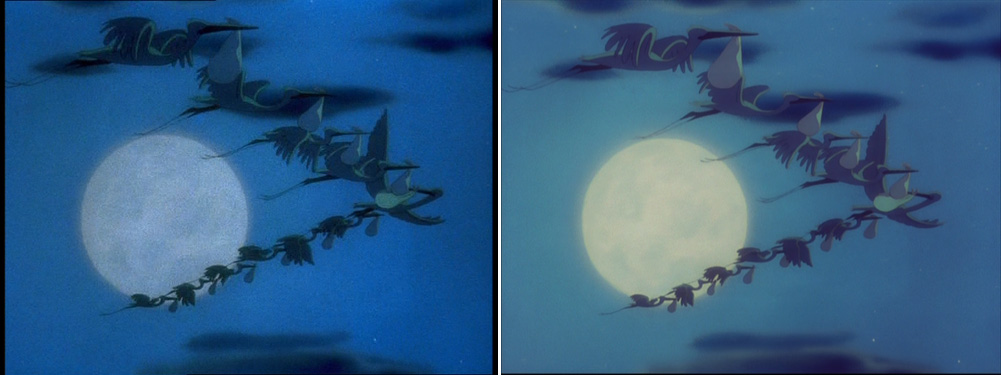
2001 (always on the left)  vs.  2010 (always on the right)

At first glance the left picture is a lot lighter. Looking at the skin color I also notice some greenish yellow tint that looks rather pale and unnatural.
On the other hand the right picture is darker and feels more saturated, although the red uniforms are a lot brighter in the left picture. Instead Mrs Jumbo's pastel cloths are more saturated. The greenish tint is gone so the green parts are in stronger contrast to the brownish yellow tent. Overall the right picture looks somewhat warmer, most notably in the skin colors. Color correction based on white balance doesn't do the job with these restorations as the colors seem to have been adjusted separately.

The obvious difference is the change in value and hue of the purple keepers. I believe what we have here is a case of "correcting" something that served a purpose. It is true that these keepers are in dark colors throughout the sequence and especially the purple ones should never have been pushed to plain red as the ringmaster is always identified by that color among them. There is also a hint in the left image that the blue of the keepers once was different from the pastel blue Mrs Jumbo cape. I also don't think that the purple (now red) keepers were meant to stand out because of that. So the left picture can't be wholly correct on that instant either.
But while the 2010 version "restoring" color continuity (making the keepers dark in ALL shots of the scene), it is disregarding the composition of the shot as a whole. This sequence is an action scene consisting of many short shots that have to read at first glance. Yes, there are many color continuity errors on Dumbo, but this wasn't one of them, I believe.

The value pattern on the right has most certainly been altered for color continuity's sake. A thing that one would never do on a live-action movie. It would never read fast enough in black and white. If you look closely enough you see spots of brighter purple in some areas. Note also that the blue keepers' hems are purple as well and not orange like in the old version and earlier in the film.

So how could the original have looked?
We, who don't have access to the studio archives, will never know (Dumbo hasn't been theatrically re-released for about 30 years around here).

Based on these pictures, does the 2010 version come closer to the original than the 2001?
On the one hand, the right image feels closer to a possible original because of the clear color separation and darkly saturated colors of Technicolor. Remember, in those days, the green layer was still printed in black as well for richer darkness. Also, the Technicolor consultants used to make sure that human skin looked warm and healthy all the time.

On the other hand the "corrected" color continuity destroys an easily readable composition. Also, the inked outlines on the keepers have been partially obscured by digital repainting (a problem of value contrast as well). When seen in motion there is a lot more going against it what with all the grain and organic flickering erased.

But which one looks better then?

Both the 2001 transfer and the digital restoration were prepared for audiences who grew up on animated features colored in the computer. With VHS and DVD visual "richness" used to be "enhanced" by pushing contrast and saturation. Over the years garish TV shows have pushed the boundaries of how many saturated colors next to each other one could bear. So subtle and rich (warm and dark) color schemes have recently been favored to lift the films off TV fare. Just think of The Princess and the Frog with all the glowing New Orleans sets that display subtlety in the form of many different shades of the same color in one image.

On a small standard TV set subtle colors were a matter of luck and the picture had to compete with brighter light sources all around the living room. So pushing the saturation and brightening the image seemed fairly reasonable. As a matter of fact, the target audience were very small children or rather their mothers and they like light and pastel colors, as marketing tells us (and them).
Look at that DVD on a HD display (flatscreen or projection) and your eyes hurt. Light surely isn't the issue with today's displays. Oversaturation is, if anything. So all that had to be pushed for standard television is now already there in the hardware. Again it is only reasonable to pull down the brightness and have darker colors saturated. In that area, the new Dumbo attempts to rival all the Princess-and-Frog-type of richness - earning much praise from critics for it.

Individual shots
Each of these pairs illustrates at least one of the above concepts. They also show that each shot has been worked over individually.

Here the left picture is brightened (look at the burnt out top of the post) while the right is maybe even darkened. All that is playing in the unlit part of the tent is treated that way. The 2010 version just goes much further than previous video versions could have dared. On the left: there's the green tint in the bright areas again. On the right: the keeper colors have not been tampered with.

Left: the straw looks like green grass on the edges and the pool of light is burnt out; right: stronger value contrast, darker like all the tent shots.


Here the left looks warmer and more natural while the right has a bluish green tint. Also Mrs Jumbo's gray trunk reads better in front of the brown sheet.

As the naughty boy's white clothes sport green stripes in all the other shots in both versions, this (on the left) may well be a painting error that was corrected (on the right) for continuity's sake.

Here it seems, the 2001 technicians feared the ringmaster's expressions wouldn't read in silhouette on a tv screen so they pumped up the brightness resulting in unappealing cloth colors. On the right the richer darkness seems to be emphasized.

The garish pushing of primary colors in older Disney DVDs was certainly pulled back in 2010 because on an average HD display red pops out anyway.

On the left, we have standard night time. The whole picture is blue like in many day-for-night scenes. This is clearly optical color grading at work which of course is common in live-action films. It might have been that way in re-release prints yet I doubt that the original was planned as a two-color scheme (blue and pale yellow) and then optically reduced to blue. The 2010 version is a lot brighter, though, showing more subtlety and supporting the thesis that for normal TVs concepts had to be pushed to the extreme to be understandable.


Conclusion: All quibbles aside, this restoration is the one looking best on today's equipment regardless of historical accuracy. Had the 2001 edition been transferred more carefully (no boosting and edge-enhancement) or from the consecutive-exposure-negative (more subtle colors and less grain) rather than from a contemporary print, it might have stood the test of time next to the aseptic Bluray.

I myself prefer the strict historical approach. Wouldn't it be marvellous to have access to the 35mm version as well? Maybe someday resemblance to the original becomes fashionable enough to be a selling point. I can dream, can't I?

the left-hand screenshots are taken from this Special Collection DVD from October 2001,
the right-hand screenshots from the 70th anniversary Bluray + DVD edition from March 2010 (Screenshots taken from the DVD which is identical to the BD except for resolution and compression). Unfortunately, neither of them includes John Canemaker’s great commentary track that is on the American 2006 Big Top Edition which I do not own.

Monday, April 26, 2010

Dumbo Link

In case you haven't noticed yet, Hans Perk from A. Film L.A. is back online! He has already started posting animators' drafts for Production No. 2006 a.k.a "Dumbo".

I hope these drafts (and Hans' invaluable efforts) are generating the same amount of response throughout the animation community as Pinocchio and 101 Dalmatians have generated.

Monday, April 19, 2010

What You See Is Not Always All You Get

When I think of female voice over narration, the following films come to mind: To Kill a Mockingbird, Cape Fear, The Age of Innocence and Cinderella. But while studying the latter's voice over narration I stumbled upon a peculiar irregularity on my Cinderella DVD when my player accidentally turned on the German dubbed soundtrack. So instead of writing about narration I found myself exploring what gets lost in translation. 
If you're only interested in the Cinderella bit, then scroll down to the corresponding pictures.

Living in Switzerland I'm used to seeing movies in their original language with subtitles (nowadays the negative influence of dubbed German television is spreading around the multiplexes, but this is another story). Having been exposed to dubs as a child I decidedly disapprove of foreign language dubs for the following reasons:

1. dialogue changes are bigger than with subtitles that basically serve as summaries of the spoken. Dubbed lines are substitutes that have to match the length and vaguely the mouth shapes of the original. While not all languages take the same amount of words to state the same, dubbing often results in odd accents and unintended pauses. The fundamental difference to a translated book or radio play lies in the fact that these are not limited by shotlengths and therefore allow for faithful literary translations.
2. Nevertheless, dubbed dialogue is always out of sync with actors' mouths and facial expressions.
3. The dubbing not only robs an actor of his distinctive voice (sometimes dubbed voices don't even match actors' bodies), but mainly replaces half of his performance. Just think of how essential nuances in the delivery of dialogue are to a performance.
4. What's more, the whole cinematic realism approach is lost when voices aren't incorporated into the sound design. More often than not they are too loud compared to the rest of the soundtrack and almost always it sounds like people close to microphones rather than sounds emanating from the pictured environment.

Overall it can turn a film into a totally different experience. For me personally point 3 and 4 are the most annoying because they keep me from suspending my disbelief. There are some instances of primarily dubbed original versions like the films of Rosselini, Fellini and most other Italian auteurs of the era when dialogue was only written during post production. As an animation counterpart to Fellini Miyazaki (and the anime tradition of post-dubbing) comes to mind. Even though initially I had the same problems with those, I still prefer to see the original versions because in rhythm, tone and sound they represent the directors' original intentions. But these films are not the issue here.

However, I acknowledge a certain necessity for dubbing when it comes to films for people who are not able to read subtitles yet, children mostly. Disney was aware of that right from the beginning and even prepared title cards and other written stuff in his early features in several European languages. With the advent of restored editions, by the time these films got to DVD, most of these carefully translated shots have gone forever. Newer films like Lilo & Stitch are available in different versions on DVD. Regarding point 2 and 4, Illusion-of-life animation lends itself easily to dubbing. Although there's a fundamental difference between building a drawn performance according to an existing voice track and dubbing it after the animation, the strong headaccents and less specific mouth shapes are a lot more easily matched than live-action actors. In fact, Disney has been doing some pretty decent foreign language versions (unfortunately not on all films and some of the original dubs from the heyday of German dubbing studios during the 1940s and 1950s have treacherously been replaced by cleaner but sloppier soundtracks).

What bugs me is the indifference with which dubbed versions are passing for the real thing. Sometimes classics are altered, even mutilated, without any acknowledgement or caveat whatsoever. I have even witnessed a scholar dissecting a classic American film without noticing that his German soundtrack was way off target. Don't get me wrong, I like different versions of a movie as long as they are declared (as a remix, director's cut, redux, final cut, the Italian cut, etc.). Nowadays at least the dubbing writers and directors are credited at the very end. 

A short bit of history
The following comparisons are sound only, so point 2 will not distract from what I want you to listen to.

Nowadays dubbing means substituting the dialogue track only leaving the tracks for sounds and music untouched. This hasn't always been the case. While Disney seems to have always prepared separated tracks for sync studios, most American studios have only done so for high "prestige" films. Before WWII, European voice actors have been brought in to dub their lines in Hollywood. During the war and afterwards, the dubbing has mostly been done in the respective countries. In Germany, every occupational sector had at least one post-sync studio.

To cut a long story short: When a studio didn't receive separated tracks, they couldn't divide the dialogue from the music and the foley and thus had to a add a different background score that often sounded more like uninspired temp music on a rough cut. 

B-pictures: changing the whole soundtrackThough producing some of the most well-aging genre classics, Film Noir was considered a low-budget run-of-the-mill back then. Just listen to this excerpt (about 55 minutes into the film) from Howard Hawks' The Big Sleep (1944/46): Someone is shooting and taking flight, Marlowe follows him in his car, then catches up with him.
The Big Sleep (1) English
The Big Sleep (1) German

In the German version, the brooding music in the car is missing. Instead we hear a highly agitated piece that conveys the same mood like during the shooting.

That was certainly weird, but listen to the following example from about 31 minutes into the film:
The Big Sleep (2) English
The Big Sleep (2) German

There is no background score whatsoever which alters the mood quite remarkably. A whole layer of commenting on the screen action is lost. Just listen to the comic bassoon motif accompanying parts of the dialogue. And this, by the way, is not some Hollywood hack at work, but the celebrated Austria born Max Steiner, a direct disciple of Gustav Mahler. I wouldn't want to know what Casablanca sounds like in German.
Not taking into account lost linguistic ambiguities of the original, points 3 and 4 are definitely at work here. Without seeing the picture you wouldn't guess that these voices are supposed to come from the same room.

Losing the distinct quality of a voice
Later on, separated track became standard. So let's focus on the voices themselves. For a voice that is fairly well-known and specific I could have picked James Stewart or John Wayne. They sure have their instantly recognizable manner of speaking, which is something dubbing voices hardly ever capture. Instead I chose Marlon Brando because with his kind of method acting there's another layer involved. Method actors don't always go for intelligibility.
Here's an excerpt from the first scene of Francis Ford Coppola's The Godfather (1972):
The Godfather English
The Godfather German

To be fair, the dubbing is relatively well done. But the rather odd quality of Brando's dialogue delivery doesn't translate that well. When you hear him mumbling with his rather high, throaty voice, it sounds as if the words are reluctant to climb out of his mouth. Speaking seems not to be one of his pleasures. The German actor sounds just like a thoughtful old man with a slightly rusty voice, but not without grip. The inherent laziness is translated quite well. The little pauses during the speech are often in different/wrong places so different words are accented. Notice that Buonasera's Italian accent is retained. You could say I'm looking for nuances, but isn't a director when directing the original performance?

Toned down narration
Translating voice over narration has the benefit of not having to correspond to onscreen mouths and accents. Even the timeframe is somewhat more open. Therefore translations can be more accurate in meaning and in tone. Let's listen to the prologue of Robert Mulligan's To Kill a Mockingbird (1962):

To Kill a Mockingbird English
To Kill a Mockingbird German

Except for the lack of any geographical hint in the voice, this German voice over does the original justice. German voice overs of the time most often sound more stern or serious than American ones, almost like sober news anchors. What we have here is a most faithful adaptation that lacks the lazy feel of the southern drawl but doesn't distort the tone much. If anything, it tones down specific traits of the original without adding new ones.
This is what voice over narration usually sounds like: in order not to give it any different meaning, the speech is delivered in High German, the standard language devoid of any regional accents. After all, this sounds sensible to me because most of the time there are no clear analogies to German dialects that wouldn't widen the gap between image and sound. I have chosen this example because it is so close in tone to Cinderella's prologue.


At a loss for words: Cinderella


As I have already stated, I grew up on dubbed versions of most Disney classics. I still think that many of them have held the test of time quite well. As a teenager I discovered the original voices and had hardly any trouble accepting them, most of them adding several layers of meaning. There is one exception, though: Hans Conried as Captain Hook. He works pretty well as Mr. Darling, but Hook for me is always linked to the voice of Eduard Wandrey. Part of that familiarity is my being raised on a couple of Disneyland storybook records that combined an adequate narrator with excerpts from the German soundtrack including dialogue, sounds and music.

So when my DVD drive selected the German Cinderella soundtrack by accident, I was rather flabbergasted. At first I wasn't sure if I was in for a parody along the lines of Woody Allen's What's Up, Tiger Lily? (1966) (I have even read about German dubbing studios during the 60s and 70s that purposely injected corny jokes into long stretches of serious dialogue).
But then, the dialogue was from the familiar 1951 dub I have always known.

Cinderella dialogue English
Cinderella dialogue German
It sounds fairly accurate, if a tad more old-fashioned which is due to different acting habits in 1950s America and Germany.

But the prologue reminded me of the fact that voice over narration is also the part that gets most easily away with changes in content. As opposed to synchronized dialogue you wouldn't be able to judge the accuracy of the direct relation to the images if you don't know the original.

Even if you don't understand a word of German, listen to this:

Cinderella intro English
Cinderella intro German

Although on my Disneyland record (dated 1969) I hear a woman narrating the prologue, on the DVD I hear this man bragging away without really telling us anything. This new introduction is said to be on the 1992 VHS but there are rumours of it already having surfaced on 1980s re-release prints (which I can hardly believe). The original narrator is none other than Betty Lou Gerson who later provided the voice for Cruella DeVil. With her southern accent that has a singing quality to it she delivers a lively retelling of the prologue that closely matches the background score and the visuals with just enough left to the imagination.

On the other hand Joachim Pukass (who replaces Erika Goerner from the 1951 dub) sounds like a mocking teacher talking down to a couple of toddlers instead of a general audience. He mainly explains that this is a Disney film coming from the US and that "Aschenputtel" is called "Cinderella" over there. He mentions this twice and also comments on the running time of the film. He speaks in commonplace phrases and glosses over everything that is in the pictures until we see the stepsisters. He then asks in a heavy-handed manner: "who is also in our story? - Oh, yes, Anastasia and Drizella". The images are rather treated like annoying background noise. The death of Cinderella's parents is omitted completely. Rumor has it that this was done in order to get a "General Audiences" rating in Germany as opposed to a "from 6 years up".

Selfconsciousness was the least of Disney's intentions with that film. It is a classic (if Americanized) fairy tale, more consistent in tone than many of his later films. And yes, in the new intro there is not a single remark or allusion concerning the dream theme that is so central to that story. Oh, did I mention that the chorus was removed from the title and end theme?

I just wish Disney would pay as much attention to their foreign versions as to the commercials advertising them.

Tuesday, March 16, 2010

Inbetween XI

My internet connection is up and running again, so I thought it was time to post something personal for a change. At the moment I'm playing around with a gigantic box of crayons my brother gave me for Christmas...
colored pencil

Coming soon: Voice Over in Cinderella and The Milky Waif, continued