Friday, July 2, 2010

Treasure Town

In my last post I have written that sometimes I like movies because they are creating a specific mood even if I’m not captivated by the plot. I also adore some movies that I would describe as gloriously failed projects. Sleeping Beauty (1959) is one of them, Tekkon kinkurito (2006)  is a more recent example. I mention them in the same breath because the American directed Anime has some of the most detailed and structured backgrounds on display. At first glance, there seems to be no space for the eye to rest on, but like with Sleeping Beauty this is no problem because the more angular (in a totally different, non-romantic vein) character design reads very well.

[For a recent discussion on the origins of Sleeping Beauty's backgrounds go here, here and here on Hans Bacher's Animation Treasure Blog.]

With regards to content Tekkon kinkurito (alluding to the Japanese words for steel and concrete) is closer to Blade Runner (1982), though. Like the famous Ridley Scott dystopia it provides us with an imaginary Asian dominated metropolis that has stimulus satiation written all over it. In this case it’s called “Treasure Town” and we’re witnessing a Yakuza/gang war about who is ultimately reigning over the city.

In this visually and accoustically overcharged environment the human eye is a symbol throughout both films. The subtext with a unicorn (Blade Runner) and a Minotaur (Tekkon) is tying them both to mythical European roots.

But while Blade Runner stands out as Ridley Scott’s masterpiece in my opinion, the story of Michael AriasTekkonkinkurito leaves me cold and mildly interested at best even though it is told through the perspective of two children called “Black” and “White”.

I admire the dynamic film making though, especially the backgrounds and colors. Contrary to so many Western films, dystopian and science fiction in particular, the color concept of this Anime is not based on the blue-steel-vs-yellow-light-cold-warm contrast.

 Blade Runner’s blue-yellow-sci-fi-look

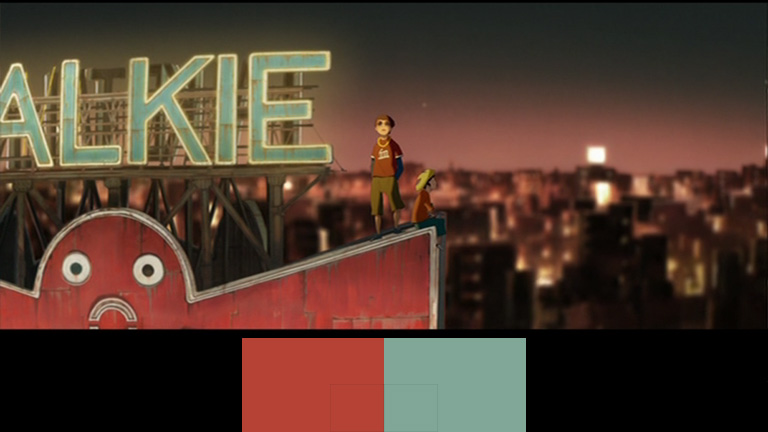
In fact, Tekkon kinkurito is not primarily based on lighting but on object colors (like so many animes). Although all four basic colors red, yellow, green and blue are present, the city seems to be structured around the complementary colors red and green.

Complementary colors
Scientifically (in the RGB spectrum), red and cyan are complementary colors.

However, throughout most of art history color theory was based on subtractive color mixing using the primary colors red, yellow and blue.

In that traditional color wheel (left), red is complementary to green (generally speaking a primary color is complementary to the equal mixing of the two others). Thus this complementary pair is still widely perceived as aesthetically pleasing.


RGB complementary colors produce grey when mixed, 
RYB complementary colors produce brown when mixed.


Since complementary contrast is heightened by human perception, placing these hues next to each other makes them appear brighter. Red and green is probably the strongest of these complementary pairs, so its effect is used in many paintings and movies (e.g. Lady and the Tramp).

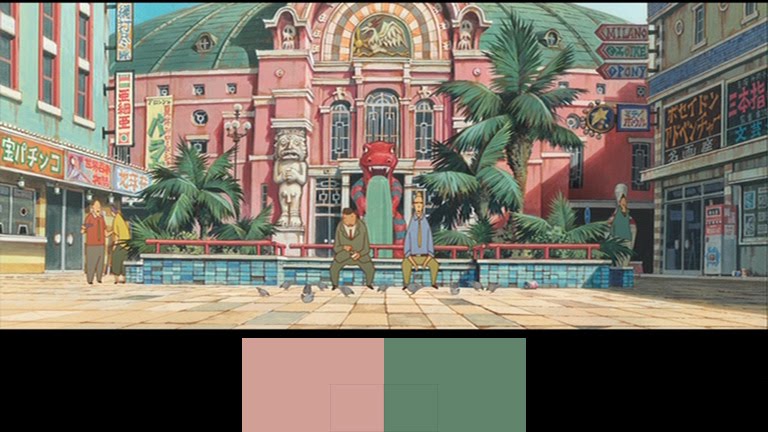
It is amazing how dominant red and green is in this city – green varying from olive to cyan, red from pink to ocher.

Just look at the following screenshots. It’s not always clear if red or green is dominant which gives the images a vibrancy without having to resort to oversaturation. Visual dominance of red or green also depends on value, saturation and the relative area each color covers in the picture.

Saturday, June 26, 2010

Annecy 2010 (2/2): short films and Andreas Hykade

Short film selection
The heart of the Annecy animation festival has always been the short film competition. This year I only saw three out of five programs. I was surprised that these 90 minute reels only contained seven to nine shorts whereas usually there were up to 15 within the same amount of time. The relative length of these shorts affected my ability to concentrate heavily. I really wished for the occasional two or three minute film that would ease the suffering of having to fight sleep during many an overlong film that began so promising. I do prefer slow-building movies over fast and flashy ones, but there has to be substance to justify the length.

Rumour has it that about 800 films had been submitted for the short film competition alone (not counting graduate films). As a result, one would expect a pretty strong competition. But it’s important to keep in mind that the preselection of films that make it into the competition (only 39 this year) is based on personal decisions by a specially designated selection committee. This year’s competition represented the selection by Isabelle Favez (Swiss director), Jennifer Oxley (American director) and Alexis Hunot (French journalist). I’m not saying that they chose the wrong films but that any other selection committee might have presented us with a totally different competition.

On a more positive note, this selection still provided a wide variety of different techniques and storytelling approaches which is why animation festivals are so inspirational. Aspects of vastly different films leave a lasting impression even if I don’t like a movie as a whole.


Strong primary colors
The vibrant color and background design of Old Fangs is one such example. One of the most important aspects for me is a film’s ability to evoke a certain mood. In recent years, excess filters and textures tended to obscure great design and flattening initially dimensional animation. I didn’t see enough films this year to say something about current trends but at least film makers are now handling textures more economically.

While the story about a cat, a fox and a wolf didn’t intrigue me much I adored the glowing evening and night colors that communicate a certain gravity that is inherent to the story. Although this kind of nostalgic color treatment has become an annoying staple in American feature animation, it looks fresh in this Cartoon Saloon produced short mainly because it was combined with non realistic water color backdrops and ornamental tree designs.

The integration of backgrounds and characters seemed more organic than in Tomm Moore’s bold Brendan feature.


My favorite film of the festival however was a short I have already seen online a few weeks before: Love and Theft by Andreas Hykade. (Watch a full-lenght version here.) With its original treatment of animation/comic history it also served as a suitable 50th anniversary celebration clip.

In my opinion it Hykade's best film to date. All his films are available online under www.hykade.de . Not all of his films are my cup of tea but their artistic brilliance can’t be denied (some of them are not safe for work, by the way). In German speaking countries, Hykade may be most well-known for his video clip for 10 kleine Jägermeister by Die Toten Hosen.

Although Love and Theft is an almost seven minute experimental film, its initial rhythmic drive never breaks down. You couldn’t tell if the music or the image came first, they feel so unified.

The progression of morphing “characters” is tightly structured. The individual steps vary in complexity of “character” design, morphing technique and color. Background colors alone divide the film in white, yellow, orange (which he calls red), blue and black segments. He seems to have a preference for the primary colors red, yellow and blue which can also be seen in his other color films.


We lived in grass (1995)

 10 kleine Jägermeister (1996)


The Runt (2005)

Love and Theft (2010)

He never used the hues as pure and saturated before, though. Love and Theft proves that flat primary colors don’t have to look cheap when handled by a master. Despite all the red there is no need for complimentary green or earthtones to balance it.
 

Sunday, June 20, 2010

Annecy 2010 (1/2): features and old fashioned 3D effects


This year’s Annecy experience was a little different for me. Not because with its 34th edition the festival celebrated its 50th anniversary, but because I came relatively late to the party (not too many tickets left) and was only able to stay for two days due to current work assignments. This is also the reason why my promised Dumbo posts have been postponed. They are just delayed, not forgotten though, so please keep coming back here.


Traditionally I like to see as many animated features in competition as possible because most of them are not getting an international cinema release afterwards. This year I’ve only managed to see The Fantastic Mr. Fox (which still isn’t available in Switzerland), so I cannot tell if its award for best feature in competition was justified. I liked it although it somehow fell short of my expectations.

I finally saw Don Hahn’s Waking Sleeping Beauty (missing the first 15 minutes due to a misunderstanding). Hahn did a fine job even if he didn’t have time to explore some of the more interesting issues. There’s nothing much for me to say about it except that I agree with most of what Michael Barrier and Michael Sporn have written about it. I was probably most surprised that animators were not labelled yet every executive was. Or as Michael Sporn writes:
“Yet the story being told - without an iota of fat - is the story of the above-the-line players and how they felt about each other. […] Only a couple of times do we really get to imagine how the artists felt about what was going on. There’s a meeting called by Katzenberg to talk about how the people felt about the period. They explained that they weren’t able to spend appropriate time with their families because of all the excess overtime that was demanded of them. Katzenberg tears up and promises that things will get better. They don’t; things get worse.“
3D backlash sold as state of the art
Then I attended the avant-première of a Belgian children’s film called Les aventures extraordinaires de Samy. The director’s claims that this film was exclusively made to be seen in 3D were more than justified. Just when you think that 3D has finally grown out of throwing things at the audience, a veritable “fourth-wall breaker” comes along that works much better as an overdimensioned rollercoaster than the uneventful story about the coming-of-age of a cutesy ocean turtle would suggest. And yes, there are these moments where a small fish is swimming towards you out of the screen (Jaws 3-D, 1983, came to mind) or a harpoon is causing you to wince in your seat.

But the 3D really works in communicating size relations: for a long stretch the turtles are out on the ocean with little else to compare their sizes to. In these scenes the three-dimensional images not only emphasize the camera position close to the water surface but also show how small these turtles are.

It was no coincidence that Samy resembles an overlong IMAX-presentation because its production company nWave Pictures and director Ben Stassen have been doing exactly that kind of IMAX show films for years (Wild Safari 3D, Fly me to the moon). While the turtles swim all over the world and still always meet the same few characters, environmental issues are present in several scenes but never really affect the protagonists or the audience, for that matter. Spilling oil and the destruction of the Amazon forest just serve as colorful backdrops. Overall, the narrative contains no real obstacles, it all just floats along without real conflict. Seeing that without the benefits of 3D-effects would be about as interesting as seeing Magic Journeys (1975) or Captain EO (1986) in 2D. Besides, it was obvious that the presented French language track was dubbed and not the original version.

French Dubbing was also the reason why I didn’t catch the first two Toy Story movies although I would have been able to get tickets. Even though I enjoyed Samy for what it was, the fact that this year’s main 3D attractions were upgraded regular movies and an old-fashioned effects-rollercoaster made me about as enthusiastic about the future of 3D like the prospects that Brad Bird is leaving animation for MI:IV and Pixar’s next few movies are sequels. I'm still looking forward to Toy Story 3 however, if only for its Michael Arndt screenplay.

To get an impression of what makes Annecy so special, read this official blog entry.

Wednesday, May 26, 2010

Brown Bears

Originally planned as a possible follow-up to Dumbo, Bongo is one half of the 1947 package film Fun and Fancy Free. Bongo’s circus scenes are of interest in connection with Dumbo but are not the subject of this post. Here, I investigate artistic choices in superficially realistic background colors.

Studying background paintings I often wonder why certain colors were chosen and not others. The obvious answer would be: because they make the picture look good. But why does it look good, what thoughts could have led the artist to favor certain colors? The artist might have followed his intuition, but it's still possible to deduce underlying concepts. There are color schemes of all kinds, some of them expressionistic, some impressionistic. But even realistic looking backgrounds are not composed by simply copying nature. The thinking behind these color choices is just not as obvious.


When I revisited Bongo I noticed how much more expensive the artwork in this film looked compared to Dumbo. Although it is still essentially an overlong cartoon, the backgrounds are painted in a more realistic style. The funny thing is that Bongo dreams in a slightly more stylized way. Once he is free, the forest backgrounds are drawn more realistically. There are cast shadows throughout, though.
dream vs. reality

Brown bears and grey trees
Bongo himself is plain brown with red clothes (balanced by primary yellow and blue).

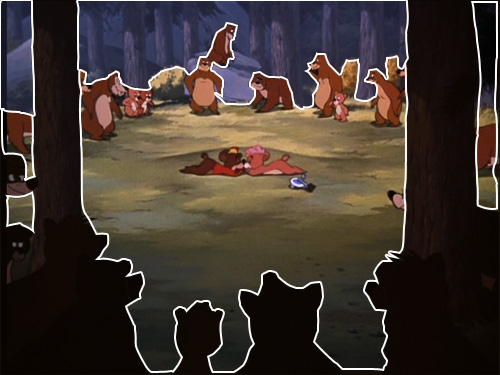
The subdued background colors are based on yellow, green, blue and grey, leaving room for both brown and red. There are hints of warm red (and therefore brown) in many colors (as always we don’t really know what the original prints looked like), but the absence of full warm brown becomes evident especially in the tree trunks. In front of these grey trees the saturated brown bears and squirrels are easily distinguished. Basically the characters are more saturated than the backgrounds. Note that Disney's 1940s and 1950s backgrounds almost always have a strong pool of light and some very dark receding areas with little detail that provide the picture with a sense of depth.
original frame as it appears on the DVD
oversaturated frame in order to distinguish the hues more clearly

warm colors (Bongo) against colder colors (tree)

Grey trees also provide a desaturated backdrop for the more saturated characters and blend in with the rest of the neighboring background colors.
Note that the tree trunk in the foreground is brown in contrast to the grey unimportant background parts. The contrast to Bongo is merely a case of value and saturation. It’s not important how well we see his feet here, the interesting part is his sad overall expression with the focus on the face.

The more blue the grey contains the colder and more distant does it feel.
In shots without visible blue sky this aerial perspective separates the planes beautifully. The blue background also provides better contrast of hue to the surrounding brown bears.

In the end when the bully Lumpjaw (according to Borge Ring via Michael Barrier a caricature of Dave Hand) is conquered, the forest is depicted in warm evening light that is far more saturated.
In the end, blue mountains and the sky provide the image with cold-warm hue contrast. Color-wise Bongo and Lulubelle are united with the warm trees. This is the first time Bongo succeeds in climbing a tree - with the help of his little forest friends, of course. On the right, the darker Bongo is on the brighter side of the tree making for nice contrast of value.

Since pink is the color associated with Bongo's love dreams there is one instant where pink is part of a background:
When Bongo sees Lulubelle for the first time, he is not sure if he's dreaming. It also makes sense that a girl wearing a pink flower is first seen framed by such flowers. The yellow and white flowers are everywhere but they don't stand out the same way because of their closeness to the general background hues.


Variations on a theme
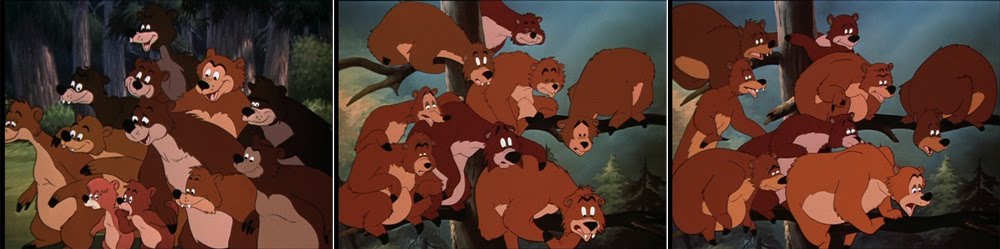
There are many mass scenes with assorted bears. Their design varies to a certain degree but is never consistent from shot to shot. Essential in giving the impression of a large variety of bears is their different coloring. To unite them they are all different shades of brown ranging from Lumpjaw’s cliché darkness to Lulubelle’s salmon color.
It goes unnoticed that the colors change in every shot because they are always in the same range. Although the middle and right image are shots from the same scene the bears differ greatly.
Sometimes the darker bears are those in the shadow that shouldn’t attract our attention (see further above where they circle Bongo and Lulubelle), sometimes the darkness is a means of separating dance groups. 
When Lumpjaw is not in the shot they are often intermingled for balanced variety. They are male or female according to what’s called upon. Males seem to be darker.


If you are interested in the thinking that went into "naturalistic" backgrounds of Bambi and Lady and the Tramp I suggest you visit Hans Bacher's Animation Treasure Blog

All screenshots taken from the 2003 DVD edition