Friday, August 26, 2011

The World's a Stage in "Cape Feare"

Episode 9F22 – originally planned as the final episode of season 4 but ending up as Ep. 2 / 5 – is one of the most popular Simpsons episodes and much has been said about the fact that this was the farewell episode of the show’s original writing team. I believe that this alone is enough of a pretext to study the storytelling and how they got the scarier moments across and told a “serious” story between slapstick rake gags, Itchy and Scratchy and a grampa missing his hormone pills.

Note: I won’t write in detail about the particular references since there are already a DVD commentary and an extensive wikipedia page full of valuable information about the making of this episode and the many different “movie connections”.

The Simpsons, a series of half-hour (or more precise 22 minute) episodes, consists of quite a lot very short scenes, some of them no longer than 15 seconds consisting of only one or two shots. So a lot of the character based humor is only possible because we’ve grown accustomed to a great many recurring Springfieldians besides the title giving family.

There is a wealth of narratively unrelated parodies, pop references and side gags in each episode, but – like “Cape Feare” – there are whole episodes based on famous movies. In the case of Cape Fear there are already two adaptations (J. Lee Thompson 1962, Martin Scorsese 1991) of the same J.D.MacDonald novel available. The Simpsons episode is closer to the more recent Scorsese version where Bobby DeNiro is hiding underneath a driving car.

One reason why a two-hour movie plot works as a 20-minute scary-comedy-operetta lies in the casting. Because we expect a certain behavior from Homer, Chief Wiggum or Lisa, it is simply entertaining to watch how these characters react to a well-known madman trying to kill Bart. And casting Sideshow Bob (Terwilliger) as the killer, we don’t even need character exposition, just a little brush-up about the townspeople’s previous encounters with Bob.

Suspense
A parody only works for people who know about or have actually seen the spoofed film. But a Simpsons episode (and every good parody for that matter) should also work as a story on its own. In contrast to many other episodes the main storyline starts right at the beginning and not on a detour.

The first third of the story is also a whodunnit.

Not even a minute after the opening credits, Bart gets his first death threat letter. This starts the game of suspense and surprise that structures the narrative emotionally. We know that Bart is really frightened because he doesn’t laugh at the violence of Itchy and Scratchy. For the next three and a half minutes he is first paralyzed by paranoia, then after learning that the police won’t be of any help in this matter he tries to reveal the killer with Lisa’s help.

About a third into the episode it is revealed that Sideshow Bob was the originator of all the death threats and that he’s about to leave the penitentiary. The suspense now lies in our expectations of how soon they will meet. After the first confrontation/chance meeting in the cinema, Bob is seen steeling his body while the Simpsons (and the audience) are given two minutes of rest when they are introduced to the Witness Relocation Program.

Even during the happy trip to Terror Lake Sideshow Bob is never far. The last third of the episode takes place in Terror Lake and again echoes the first third with Bart being frightened by Homer bursting into his room with a knife and a chainsaw.

The final confrontation on the houseboat only lasts for about two and a half minutes with Bob’s singing the “H.M.S Pinafore” taking up more than a minute. Nevertheless, within the 21 minute episode the sequence feels quite long and memorable. The suspense plot arguably loses momentum when Bart outsmarts Bob with his last request (a classical countdown suspense scene that somehow doesn’t create the tension it should). But the police capturing Bob because the boat passed by a brothel and Abe Simpson turning into a woman end the episode on such a funny note that we forgive the otherwise squibbed climax.

Expressionist Lighting
As we have seen, much of the suspense comes from the anticipated confrontation of Bart and his pursuer. These scenes work because of the way they are written, therefore they are mostly staged in standard TV show style (high key lighting, no extravagant angles).

The Scorsese topshot (left); Bart is scared, doesn't this cage remind you of The Birds? (right)
Surprises and scary situations on the other hand benefit greatly from – or are even generated by – audiovisual elements and effects. So it’s no wonder that “Cape Feare” employs subjective lighting and other horror clichés more heavily than the average Simpsons episode.

Whether someone seems scary is largely based on a subjective perspective. Consequently, people who look threatening to Bart also appear in a different light and from more unsettling angles.
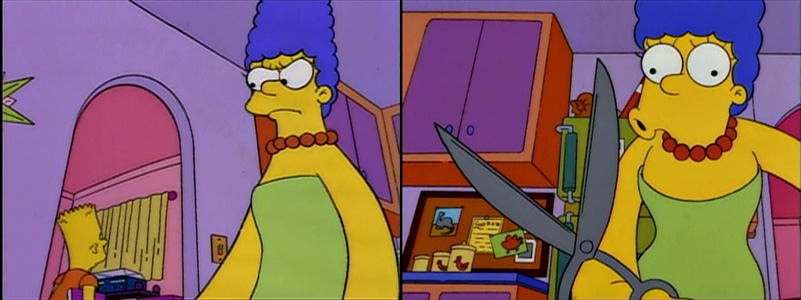
The first subjective scary moment: Marge depicted from an extremely low angle.
Ned Flanders also from Bart's low point-of-view; There's an additional backlight effect as Bart gets tenser.
After all, there is an clear-cut open villain at work, not some mystery killer who is only revealed in the last act like in a whodunnit.
Tilt angles and strong low-key lighting to make Bob's entrance scarier (and more campy).
When Bob gets angry in the parole board room, the lighting changes like on a theater stage...
...and back again, before he talks to the board.
Later in the cinema, Bob only turns green when scaring Bart (or trying to).
Bart does not seem to be scared by Bob lying in the streets (no shadows). At the Bates Motel (tilt angles) there's low-key lighting all around while Bob is writing a diabolical note.
Again extreme angles, low-key (cast shadows), a Hitchcock/Scorsese topshot (god's eye view) from where we see that it is Homer after all...

...but Bart sees it much more expressionistic.
Now that all devices are used, the progression is in the way Bart's reaction is animated.

When Bob comes aboard, he is not scary (straight angle, another rake gag), but soon afterwards he's back in villain mode and tilt angle/shadows.

This time it's not Bart's imagination playing a trick on him. It's the real thing, there are no subjective colors.

Comedy: flat, no shadows...

...threatening again: tilt and low key lighting.

A Stage Show
There’s no question that such lighting looks artificial and theatrical, especially in a cartoon where ambient light and cast shadows are generally absent. In addition to spoofing and exploiting our knowledge of horror films, the theatrical staging is a recurring theme on many levels.

As if foreshadowing* the “final curtain” Bob refers to after singing the complete score of a Gilbert and Sullivan operetta, the episode starts with an elaborate broadway show couch gag that has been heavily critized because it was re-used from an earlier episode.

The TV show the kids are watching before Bart gets his first letter opens with so many curtains that it’s hard to miss the staging reference here.


The nature of a staged TV show is later parodied during the Witness Relocation Program when the Simpsons become the Thompsons and there is an all-new couch gag. Parallels to the popular film-within-a-film or musical-about-staging-a-show genres could be drawn here.


The stage and acting theme is also referenced when Martin is wearing women’s clothes in order to play a murderer in a school theater production (and yes, we see the Bates motel later on). It visually foreshadows not only Homer’s disguise as Jason but also Gampa’s hormone problem.

So it doesn’t come as a complete shock when Bob and Bart put up an full-blown operetta performance with obvious props and improvised costumes and all. Visually, the final curtain falls in the form of a Union Jack (see images above).

The visual representation of the dramatic/theatrical theme is supported by a memorable soundtrack that incorporates Bernard Herrmann’s Cape Fear leitmotif for Sideshow Bob, the Thompson family singing in the car and an abridged Gilbert and Sullivan score performed by Kelsey Grammer.

* There is one favorite instance of foreshadowing that is only marginally related to the staging theme: When Bob tells the parole board that “Die, Bart, Die” is German for “The Bart, The”, a board member says under her breath that “no one who speaks German can be an evil man”. Only minutes earlier we have been reminded of Germany’s violent past in one brief shot of a TV announcer in uniform (who introduces a homophobic TV host with a German/Austrian accent talking about the “music guy’s” costume).

Monday, August 8, 2011

Pooh vs. Pukh, a character analysis

My interest in storytelling and defining screen characters led me to analyze two very different yet faithful adaptations of Alexander Alan Milne’s children’s classic “Winnie-the-Pooh”. It just so happens that Wolfgang Reitherman’s first Disney adaptation Winnie the Pooh and the Honey Tree (1966) is based on the same two chapters as Fyodor Khitruk’s first two Vinni-Pukh (1969/1971) films, both of them about ten minutes long per chapter. However, Pooh and his friends come across as quite different characters in these two versions of the same simple story. 

The first two chapters of A. A. Milne’s book “Winnie-the-Pooh” from 1926 are built around Pooh’s incessant appetite for honey. In the first one he fails to get honey out of a treehole inhabited by bees, in the second one he climbs through another hole into a rabbit burrow and eats so much honey that he gets stuck when trying to climb out.

While Milne concentrates on Pooh’s relationship with Christopher Robin (CR) in the first chapter and introduces the good-mannered rabbit in the second, he only mentions the other characters in a sort of preview of later chapters. After all, Pooh is Christopher Robin’s favorite toy bear and CR is the narrator’s six year old son who wants his daddy to tell Pooh stories about himself, Pooh that is. In fact, Milne’s own son was called Christopher Robin and the book contains many a conversation between father and son in parentheses.

Thus, one might say the self-reflective narration has always been part of the appeal of the Pooh stories. So there’s no wonder that both the Russian and the American adaptations feature voice-over narration and characters looking into mirrors or even straight at the camera.

Literal but playful and appealing
The way Khitruk and Reitherman differ in how they incorporate the narrator and CR into the story is essential to the way they handle the characters and their on-screen relationships. They both seem to do Milne justice on different levels, though. True to Disney’s literal “illusion of life” paradigm, Reitherman frames the animated segments with a credit sequence over live-action footage of a deserted nursery full of stuffed animals and a book of Winnie-the-Pooh which belong to a boy called Christopher Robin “and they all live together in a wonderful world of make-believe”.

This ghostly human world feels as artificial and lifeless that it seems only natural to see the book open all by itself. As it turns out, there is no connection between the English narrator (Sebastian Cabot) and the American animated boy Christopher Robin whose voice belongs to director Reitherman’s son Bruce (later the voice of Mowgli). This Pooh story is obviously told to us and not to CR.

Since the original stories already lack any opportunities for emotional involvement (or Disney sentimentality) the film makers have cleverly expanded the concept of characters inhabiting a printed book, no matter how distancing this may turn out. The original self-reflective conversations between CR and his narrator-father have been translated into occasional interactions between Pooh and the narrator.

Yet the printed book and the carefully rendered illustrations support the notion that this is a children’s story told from an adult’s point of view, fondly looking down on the lovable characters like one is looking at a young child. After all, Pooh is only “stuffed with fluff” and “of very little brain”. The stories in this book might fuel a child’s imagination and role play, audience involvement is not as immediate though because of this additional layer.

Diving into that world


Khitruk’s narrator, on the other hand, is in no other relation to the characters than faithfully narrating their story. When these characters look at the camera, they may look directly at us or appear to think something that we don’t know about. By eliminating the meta-level that both Milne and Reitherman used to indicate the child-like make-believe world of embarking on adventures with forest animals and stuffed toys alike, Khitruk is able to eliminate CR and humans in general.

Thus, the director creates a world of immediacy itself, a universe where Vinni Pukh and his friends are very much alive, not as forest animals or stuffed toys but as “real” characters with no traces of human interference, there’s no distancing book involved.

A narrative that follows children’s logic is ideally suited for a visual style that has the warmth of children’s drawings. After all, this artistic illustration style was much more contemporary in 1969 than the timeless Disney-fied Shepard imitations (I happen to like so much). So Khitruk even manages to discard the “literary classic” or nostalgia dimension of Reitherman’s film without compromising Milne’s spirit.

Although breaking the concept of either style, both films give us a point-of-view up-shot at the "black rain cloud".

Probably the greatest advantage of such a conventionalized, two-dimensional style is the fact that the characters don’t need to be animated in an “illusion-of-life” fashion. The obviously skillful Russian animators have found a naïve style that allows very laconic and deadpan comic performances.
Rabbit is all excited, in Khitruk's style tilted glasses do the job.

Characters
The gopher that is "not in the book".
Although only Pooh, CR and Rabbit appear in the first two chapters, Reitherman sneaks in the whole gang of Pooh characters from the first book as extras – except for Piglet (instead there is a much criticized American gopher that is “not in the book”). Piglet however is mentioned in the preface of Milne’s book and comes off as a small but somehow jealous guy who would love to be as popular as Pooh.


By substituting Piglet for CR, Khitruk gives Pukh a screen partner who unlike CR is not considered mentally superior. Thus, characterized by his relationship with Piglet (Pyatachok), Pukh comes off as a distinct character quite different from what we are used to from the Disney version. Apart from the fact that he hardly ever smiles at anybody he also walks and talks in a swift pace. Especially in the second Pukh film, Piglet is breathlessly trying to keep up with him.
Piglet replaces Christopher Robin


Milne’s Pooh
But before comparing the different film characters, let’s have a look at how Milne characterizes Pooh in the book: According to the narrator, Pooh is CR’s favorite toy and likes to play a game, sit quietly in front of a fire or listen to a story, preferably about himself (as CR remarks). He also likes to make up songs and poems which he sings/hums when wandering about aimlessly. His thought process seems to be slow and steady and he talks to himself. All in all, he is pretty confident that his plans work. And above all, he has an insatiable appetite for honey.

In the second chapter we also learn that he is capable of self-reflection: He exercizes in front of a mirror and afterwards thinks about what it felt like being somebody else. Yet he is persistent enough not to believe Rabbit’s polite way of trying to get rid of him by posing as somebody else or even “nobody” (“But this is Me! – What sort of Me?”). In fact, Pooh doesn’t get the concept of saying things out of politeness at all. When he’s stuck he’s embarrassed and even crying at the prospects of not eating for a week, but it never occurs to him that this situation might have been uncomfortable for Rabbit as well. In his case, social ignorance leads to resilience and one couldn’t even be mad at him for that. E.H. Shepard’s illustrations hardly show any strong facial expressions.

Reitherman’s Pooh
The stereotyped thinking gesture.
Sebastian Cabot introduces Pooh as a lovable bear with very little brain and an insatiable appetite for honey. We see Pooh exercising and talking to himself in front of a mirror (self-reflection). He’s obviously a Teddy Bear. His voice (Sterling Holloway) is rather high but slow and charming, he always smiles and there is a stereotyped gesture to show his thought process. He speaks not only to himself but also to the narrator and sings whenever he is on his own, sometimes supported by a choir that emphasizes the mood of warm American nostalgia right from the title song.

Talking to himself and stuffed with fluff.
Another framing device.
This happy-go-lucky Pooh might be regretful but never angry or hurt, he even laughs when he bangs his head to a branch. The first person he thinks of is not CR but “Winnie the Pooh”. But like in the book, he relies on CR to get him out of tight places. Yet, the narrator tells us, Pooh is not “the sort to give up easily”. When he put his mind to honey, he stuck to it. He may always be happy and not be able to think a bad thought but he certainly can’t read other people’s feelings/intentions. After eating all Rabbit had, he’s simply disappointed that there’s no honey left, and – like in the book – doesn’t think about what he inflicted on Rabbit by getting stuck in his front door.

Khitruk’s Pukh
Although the harpsichord title tune and the fairy-tale narrator suggest a deliberate pace, Pukh himself is quite the opposite. Before we see him, we see his tracks and the narrator tells us that he always likes a snack and that he’s a poet writing verses and even small songs. As I’ve written above, Pukh is walking and talking swiftly and comes off as rather gnarly, especially when he sings. He shows hardly a facial expression and pauses from time to time looking into the camera and guessing what to say or do next. His blank looks are funny in itself and combined with brilliant timing define an animated performance as laconic as anything Buster Keaton or Kaurismäki have done.

He is a slow thinker, though. During his first conversation with Piglet he hardly makes eye contact and speaks in choppy phrases. He treats Piglet like a younger brother whose always one step behind but running to catch up. Piglet seems to look up to Pukh and do whatever he demands. Although Piglet is eager to help Pukh, he is still better at doing some things like inflating a balloon.

The emphasis on relationships and character interaction becomes especially apparent in the second film/chapter, where Pukh only gets stuck in the end for a few seconds. Instead the honey-eating part is expanded to show how Pukh is ignorant of the whole politeness concept and how he bosses around Piglet without coming off as a tyrant. In fact, Pukh not only washes his little friend’s face, he also ties a napkin over his mouth so that Piglet isn’t able to eat or say anything during the whole meal. Pukh soon forgets about his proudly displayed social manners when he learns that there is still more food for him.
Although Pukh only thinks about Rabbit's honey...

...he still remembers his manners.
What really makes these characters come to life are such small gestures like in the end when Pukh tries to grab Piglet’s hand to run off with him.

Final Thoughts
Having grown up with Disney’s Pooh featurettes, I was slightly disappointed the first time I saw Khitruks Vinni Pukh not because of its visual simplicity and charming stylization but because it was built around a different title character and most of all, everything I loved about Winnie the Pooh – notably the book and narrator interactions – was missing from this version.

Only after seeing all three Khitruk shorts a second time I began to see why everybody in Eastern Europe was so fond of Pukh. Gradually, the brisk pace and singing became a valuable alternative to the laid-back style of the Sherman Brothers’ songs that in my mind had become synonymous with Winnie the Pooh.

Although both film versions follow the book very closely, even down to the dialogue (according to the subtitles, at least), Khitruk’s substitution of CR with Piglet sounds like a major change but ultimately leads to less detached storytelling than in the Disney version. Pukh’s relationship with Piglet gives us an additional dimension not present in Winnie the Pooh and the Honey Tree* because it doesn't show when Pooh talks only to CR who he looks up to and not Piglet who looks up to him.


After all, and this is true for both adaptations, isn't it refreshing to have a protagonist who only cares about his well-being and never thinks about how his friends feel? Actually, the quirky Russian Pukh is also a more interesting character, simply because he isn’t always happy. I think it’s interesting to see what small decisions can lead to two different characters in roughly the same story.


*Piglet is present in later Disney featurettes, of course, but comes off as a rather different, timid and even stupid character.

Friday, July 15, 2011

Oh Bother! Yet Another Pooh (NO SPOILERS)

Around the time Winnie the Pooh (2011) was released last spring, someone asked me whether Disney’s many Pooh films always told the same story and I had to admit that I’ve lost track of which element popped up in which featurette. Having more recent memories of the Russian version that also follows Milne’s chapters very closely I found it was time to take another look at both The Many Adventures of Winnie the Pooh (1966-77) and Fyodor Khitruk’s Vinni Pukh (1969-72) to clarify the situation.

While I’m not interested in meticulously relating the Milne chapters to the many film versions here, I like to share a few thoughts about the new Pooh today (its US release date) and have a closer look at the way Disney/Reitherman and Khitruk tell their stories, respectively, in a future post.

It was probably the first time ever that an animated Disney feature was released in Switzerland months before its American release date (on April 14, to be precise). Although it wasn’t eclipsed by Harry Potter it understandably went under the radar of most moviegoers and wasn’t perceived as the major Disney release of 2011. After numerous direct-to-video features and an omnipresent TV-show the prospects of yet another return of the (meanwhile trademarked) Disney-fied Winnie the Pooh were not especially exciting, to put it mildly.

Apart from my intention to see every theatrically released hand drawn Disney feature at least once (consciously avoiding upgraded direct-to-video releases like Bambi 2), there was another – wholly unexpected – reason to see it: the poster.

Although this is one of those familiar promotional group pictures where the characters are not really interacting or aren’t even arranged in an overall pose, it told me very clearly what to expect. All the characters are on the lookout for something to fight against except for Eeyore who is missing his tail and Pooh at the center who is looking for honey. There’s not much overlapping and we see the silhouettes very clearly so the animals appear as individuals rather than a tight-knit group.

But what intrigued me was the horned silhouette that gives us a hint of what the animals’ opponent might look like. It also reminds us that they might be once again chasing a figment of their imagination because they see things differently than they are – after all, it’s just a tree-top, anything else is interpretation at this point.

Mildly enjoyable, but really more of the same
The film itself is not bad measured by the three Pooh shorts that made up The Many Adventures of Winnie the Pooh (1977). Closely inspired by some of A.A. Milne’s original Pooh stories the 2011 edition is able to capture the spirit of chasing one’s own shadow that made the early shorts so charming to me. All the familiar elements are intact and feel more of a piece but less inspired than before. It seems only consistent that the main feature is accompanied by a narrator-driven short that has “retro” and “hommage” written all over it.

Paul Felix (with Patrick Sullivan and his team) has to be credited for translating the 1960s water color background style to the computer era. As expected, the pencil clean-up is a lot less charming (with fake construction lines that are sometimes not even in the right place).

At first, I resented the redesign of Christopher Robin who now looks even blander than ever with his newly white eyes instead of the charming buttons. But considering the logic of having white eyes for real forest animals and button eyes for stuffed animals it is only appropriate. Eeyore seems to be an exception to the rule, but then maybe sad eyes aren't possible with buttons and he really isn't made of fluff inside his head... who knows...


Story less episodic, characters still simplified
The biggest difference is that this time the supposedly three Milne stories are interwoven rather than told as separate episodes, so despite a running time of only about an hour the new movie feels more like a feature than the 1977 film. Combining the elements of several chapters into one long episode has the advantage that the story arcs can be expanded without having to come up with more complex information within each narrative thread and the plot points can be dispersed more evenly across the film.

Familiar diversions such as song- and dream-sequences in different drawing styles and tongue-in-cheek elements try to mask the fact that Pooh and his friends are still serial characters who therefore can’t have a real character arc, i.e. undergo real changes.

Pooh himself is maybe telling us one too many times that he’s a “bear of very little brain” (as opposed to just being a “silly old bear”) which reminded me of Kung-Fu Panda’s Po. Piglet is acting less timidly than outright stupidly, which is a pity. All things considered the characters are coherent within the Disney-Pooh universe. Given the simple story and the amount of dialogue scenes I believe the opportunity to write (and animate) more complex characters without losing their established personality would have been there.

As always the book and narrator are part of the story with the letters probably more emphasized than in previous versions. Although the story contains many elements of Chapter Five in which Rabbit has a busy day, and we learn what Christopher Robin does in the mornings from Milne’s “House at Pooh Corner” with its many references to reading and spelling, the most interesting part of that chapter unfortunately didn’t make it into the film, although it would have contained the potential to explore Eeyore’s character beyond the “everything happens to me” attitude:

Eeyore had three sticks on the ground, and was looking at them. Two of the sticks were touching at one end, but not at the other, and the third stick was laid across them. Piglet thought that perhaps it was a Trap of some kind.
‘Oh, Eeyore,’ he began again, ‘I just –‘
‘Is that little Piglet?’ said Eeyore, still looking hard at his sticks.
‘Yes, Eeyore, and I –‘
(original colour illustration by E.H.Shepard)
‘Do you know what this is?’
‘No’ said Piglet.
‘It’s an A.’
‘Oh,’ said Piglet.
‘Not O – A,’ said Eeyore severely. ‘Can’t you hear, or do you think you have more education than Christopher Robin?’
‘Yes,’ said Piglet. ‘No,’ said Piglet very quickly. And he came closer still.
‘Christopher Robin said it was an A, and an A it is – until somebody treads on it,’ Eeyore added sternly.
Piglet jumped backwards hurriedly, and smelt at his violets.
‘Do you know what A means, little Piglet?’
‘No, Eeyore, I don’t.’
‘It means Learning, it means Education, it means all the things that you and Pooh haven’t got. That’s what A means.’
‘Oh,’ said Piglet again. ‘I mean, does it?’ he explained quickly.
‘I’m telling you. People come and go in this Forest, and they say, “It’s only Eeyore, so it doesn’t count.” They walk to and fro saying “Ha-ha!” But do they know anything about A? They don’t. It’s just three sticks to them. But to the Educated – mark this, little Piglet – to the Educated, not meaning Poohs and Piglets, it’s a great and glorious A. Not,’ he added, ‘just something that anybody can come and breathe on.’

So while the opportunity to further explore the well-known characters is ignored throughout, the story focuses on the “storm in a teapot” elements (like chasing a Backson and finding Eeyore's tail) decorated with mandatory, uplifting messages about friendship. A storm in a teapot, little more, is what this gentle imitation of – rather than a sequel to – The Many Adventures of Winnie the Pooh really feels like.

Friday, July 1, 2011

Scorsese vs. Hitchcock: Camera as Character

Travis is introduced through his eyes and his reflection in rear-view-mirrors.
One of my favorite fields of interest in films of any kind is narrative point-of-view. This post may be about live-action films exclusively, but since animation artists are essentially film makers we can learn a great deal from analyzing the thinking behind two very controlled directors’ decisions. There are mild spoilers ahead, as always when classics are debated, so if you haven’t seen Hitchcock’s Psycho (1960) or Scrosese’s Taxi Driver (1975) yet, go see them, they are great examples of what night-time cab-driver Travis calls “morbid self-attention”. And hey, they both are masterfully scored by Bernard Herrmann and are available in stellar image quality on Bluray!

Film history provides us with a wide range of psychological studies that are essentially told from a character’s subjective perspective. With the exception of Robert Montgomery’s Raymond Chandler adaptation Lady in the Lake (1947) the camera doesn’t usually limit itself to the literal point-of-view of the first person narrator.
Lady in the Lake: a whole movie composed of point-of-view shots.

In fact, we are accustomed to the convention of seeing a character within the image and still accept it as his personal vision of reality. Yet in many subjective movies – particularly the ones dealing with voyeurism – there are moments when the director intentionally breaks the concept and either shifts the narrative’s point of view to another character (Brian de Palma’s Sisters, Alfred Hitchcock’s Vertigo) or – more interesting – has the camera see things that no character inside the movie could see. 

Voyeurism and self-reflection
The principal visual leitmotif of Taxi Driver is the mirror. We are introduced to protagonist Travis Bickle by seeing his eyes and their reflections in the rear-view-mirrors of his taxi before we see anything else of him. There’s no doubt that self-reflection is the central theme that is perhaps most obviously illustrated in the famous mirror-scene (“you talkin’ to me? Well, I’m the only one here.”).

But Travis is also a voyeuristic substitute of ourselves as movie spectators – observing what goes on around him rather than being part of it – and he more disturbing, this leads him to become a murderer. Even without being aware that composer Herrmann cites his own Psycho motif just before Travis kills for the first time, the connection to Hitchcock’s “peeping tom” Norman Bates can be easily seen.

While Scorsese – with the exception of one and a half scenes – confines the narrative to Travis’ point of view, Hitchcock radically changes our perspective from a thief (Janet Leigh) to an obsessive murderer (Anthony Perkins). From that point on we also share the knowledge of his pursuers which is the basis of Hitchcock’s suspense technique. 

Manipulation vs. distancing effect 
Taxi Driver however is not a crime thriller since no one is really paying enough attention to Travis to pursue him – or at least we don’t see them. Furthermore, the two directors have fundamentally different agendas. Hitchcock uses subjective narration to manipulate our emotions so that we are as thrilled that we don’t question the logic as long as we are watching his films.

Scorsese on the other hand is constantly trying to disorient us with subtle jumpcuts and other Nouvelle Vague techniques to slightly distance us from morally ambivalent Travis. Even though he gets us interested in Travis’ life (the sentiments might be fascination as well as pity), he encourages us to reflect on what we see. He does so most obviously in some shots that are held longer than the information they give us needs to sink in, so that we become aware that we are watching a movie which would clearly break the suspense of a Hitchcock movie.

He also gives us moments of rest after something emotionally excruciating happened. In Taxi Driver the longest “pause scene” is the song that plays after Travis’ first murder. There is also a brief scene after he tried to kill the senator and Travis sits even down in the middle of his “roaring rampage” right after he killed Sport. Of course, in a Scorsese picture the distancing effect is never as dominant as in a Brecht play or a Godard film. 

Borrowing from horror movies
In the Criterion director’s commentary, Scorsese reveals that he applied techniques of classical Val Lewton/Jacques Tourneur horror movies to suggest Travis’ paranoia. One of the examples I found is when Travis first enters the brothel with Iris.

In the following video we first see a classic suspense situation from Psycho and then the analogous scene from Taxi Driver. It’s interesting to see how much of Psycho is composed of simple shot-reverse shot scenes (the basic cinematic difference to theater) with extreme control over what is revealed at what time.

The Taxi Driver ends on a jump cut to De Niro in the room, which might not be noticed consciously but adds to the sense of uneasiness. More interesting, at the beginning of the excerpt, we believe that the camera shows us Travis’ point of view while the reverse-shot shows us that he hasn’t yet entered the room. 

Camera as additional character
We don’t normally perceive camera moves as long as they are reframings in order not to lose the actors from sight. We also accept camera moves along a character’s personal stuff inside his apartment, especially if the move ends on the person who lives there.

Hitchcock however likes to use his camera as an additional character who moves independently from the actors and points towards what he wants the audience to see. He always uses this device to give us additional information and heighten the suspense (while emphasizing a red herring once in a while, too).

In his British comeback film Frenzy (1972) we already know that a red-haired neck-tie murderer strangles women after telling them “you’re my type of woman”. Like in many scenes of Psycho and Taxi Driver the camera is positioned in a staircase while we see the murderer and his victim ascend the stairs. Once we heard the crucial sentence, we don’t have to see the murder to know what’s going on. Instead, the camera character tracks down the stairs and out of the house where we learn that no one will notice the murder because of the noise outside.


Both of Hitchcock’s observing cameras are clearly intended to transport information to the audience.

In Taxi Driver, however, there’s a scene where Travis is talking to Betsy on the phone one last time. According to Scorsese this is the key shot of the film and first that came fully formed to his mind when starting work on the film.
Here the camera, like in an Antonioni or Huillet/Straub film, moves independently away from Travis, but we only see a corridor. Scorsese repeatedly said that this conversation was too painful to watch, so he wanted to pan away from it. At the same time, this gives us one of those shots that outlast our expectations. From our subconscious movie knowledge we either expect someone coming through the corridor or out of one of the doors. The non-existing moment of suspense fizzling out, though, once we see Travis enter the frame from the left. 

Camera as transcendent observer
The last video starts with a scene from Psycho that pretends to reveal the long-awaited visual information about Norman’s mother. Ultimately, Hitchcock manages to deceive us once again, though, by having the camera perform a move that suggests a free floating agent who can assume any perspective, even one that is usually attributed to god alone.

typical Scorsese rostrum shot for rituals.
Scorsese (like his apt pupil Wes Anderson) likes these top shots a lot. Especially his 1990s films like Goodfellas (1990) and Casino (1995) are rife with god’s-eye-views that have been said to represent not only the point-of-view of a not-so-goodnatured divine being but also the point-of-view of a priest during consecration (looking down on the communion table). Therefore he often uses such rostrum type shots for ritualistic moments. In Taxi Driver we see it when Travis applies for the job, when he asks Betsy out on a date and when he purchases and handles the guns for his ritualistic killing.

He comes back to that perspective in the end, when the camera slowly observes Travis’ trail of blood and finally leads into a homage to the Frenzy scene described above.

There are also some more explicit intertextual references as in all of Martin Scorsese's works. A good account of many of those not documented on the imdb can be found in this essay by John Thurman.


Recommendation: Sony’s new Taxi Driver BD is among the best restorations of a 1970s film so far. Contrary to current practice the picture is not enhanced or “fixed” but just restored to what it looked (and sounded) like in 1976. The heavy involvement of Scorsese and cinematographer Michael Chapman made sure that even the overly grainy Columbia logo used during the 1970s was kept intact.

The main difference to most of the earlier DVDs is that they were “color corrected” towards a colder white/blue whereas the film was always intentionally more yellow/dingy. Even the altered colors of Travis’ bloodbath are still in the grainy sepia look that made the artificial blood look much better than in other violent movies of the time. In short, it looks rather like film than like a super-enhanced DVD.
all comparison images lifted from DVDbeaver.com
For DVD comparison see DVD Beaver's review. Don't be fooled by the relatively small difference in sharpness of the stills. Seen in motion this Bluray really looks like film rather than video and vastly superior to all previous editions. 

For more information about the restoration process: Digital Bits interview with Sony's Grover Crisp.

Monday, June 20, 2011

Please bear with me...


If you happen to live in Switzerland, you might be interested to know that on June 29 at 8.15pm there will be a special Taxi Driver screening of the digitally restored BluRay edition in the cinema Seehof in Zug. I’m also posting this because preparing my introduction to and lecture on this masterpiece is part of what kept me from writing lately. Martin Scorsese is one of my favorite directors and the 1970s are among my favorite historical periods in regard to American movies. 

Sony’s Taxi Driver restoration is probably the most faithful digital presentation of a New Hollywood movie so far and therefore highly recommended.

It’s been more than a month since my last post and honestly, I don’t really know when I’ll have the time to post something more substantial. Looking at my Google Analytics page I can’t help but notice that the daily traffic – that was steadily increasing until a few weeks ago – is now steadily dropping to about half of what it once was. I regret that especially since I was really pleased to discover that this blog has now more than 250 public followers. Thanks for reading my stuff!

Two posts a month should be manageable
The only saving grace at the moment are plugs by the likes of Michael J. Ruocco’s Animation Smears that are featured on cartoonbrew. So in order not to lose too many of you I try to establish a steadier posting rhythm, so to speak, that is still manageable during busier times. My plan is to come up with a new post twice a month starting in July.

I could do a lot of short industry and festival news posts inbetween just to keep the traffic going, but firstly I think that there are already more than enough information sites and secondly I don’t want the longer articles to be obscured by them. Instead I will stick to my practice of previewing animation events and plugging interesting sites once in a while without being able to do justice to all the interesting information I receive.

So I hope you understand that not reviewing a short film, website or festival announcement doesn’t mean that I didn’t like it. It’s just that there are other things on my mind, too, that consume my time. And – you might have guessed it – I’m a little obsessed with researching a lot before I dare to write about something.

Special sites for special posts
As you may have already seen, I have organized the most popular posts on special sites just below the header making it easier to directly access them. Hopefully, this will keep you interested during low tide.